

Digest of the day
November 22, 2026
10 stories
Sky Media unveiled Outcomes Accelerator, letting advertisers optimise addressable TV campaigns in-flight against business outcomes, while ARIR found up to 6.81% invalid traffic in Russian display and video campaigns. Affle's CRO says Indian advertisers are shifting roughly half of migrating linear TV budgets and up to 30% of mobile video spend into CTV, despite a 2.5x to 3x CPM premium.

ARIR's Online Branding committee publishes first attention-measurement White Paper
Russia's Association for the Development of Interactive Advertising (ARIR) released its first White Paper on measuring user attention to digital advertising, produced by the association's Online Branding committee. The document aims to standardize terminology and give advertisers, agencies, ad platforms, tech vendors and research organizations a shared basis for comparing attention metrics across different platforms and verification tools. It covers the attention-measurement ecosystem, deterministic online measurement, offline neuro-research and predictive modeling built on AI and machine learning, with separate chapters on technical requirements, a roadmap toward industry benchmarks and practical case studies. Co-chair Anna Bochkaryova, head of programmatic at Weborama, said the paper is meant to become a basis for unified industry approaches and for comparing inventory across channels as data accumulates. The White Paper stops short of setting a single calculation method or naming one technology as the industry standard.

RESONEO study: ChatGPT skips JavaScript, keeps only ~200 characters near a page's H1
RESONEO's study, published August 17, 2026 on Search Engine Land, found that ChatGPT reads a web page's static HTML only, skipping any JavaScript: it strips out scripts, iframes and JSON-LD markup, keeps text from image alt descriptions, and retains about 200 characters around a page's H1 heading, the same snippet for every query. Meta descriptions go unused. The findings describe ChatGPT specifically; sostav.ru notes the same logic likely carries over to other assistants, since any AI tool needs text present in a page's source code to read it. Mediascope's data for October 2025 show that 26% of Russians over 12 used an AI service at least monthly, about 5% weekly, with Alisa AI reaching 14.3%, ahead of DeepSeek at 9.4%, GigaChat at 4% and ChatGPT at 3.5%. Yandex has said that, as of July 29, 2026, around 10% of Alisa AI requests involve product search or purchases, a figure from Yandex itself with no independent verification and no wholesale breakdown.

Sky Media launches Outcomes Accelerator, a performance tool for addressable TV
Outcomes Accelerator, a new addressable TV product unveiled by Sky Media at its annual event in London this week, lets advertisers plan and optimise campaigns in-flight against business outcomes. The tool draws on Sky Media's effectiveness databank to predict performance and shape the initial media plan, then uses in-flight data on the most and least responsive households to refine delivery as a campaign runs. Sky says the capability mirrors performance tools offered by many of the big tech platforms and extends its addressable TV offering further down the marketing funnel. Outcomes Accelerator is already running in beta across live campaigns, with a full rollout planned for next year. Sky Media also used the event to expand its digital-first publisher network, adding Platform Media, Goalhanger and 1071 Media, with YouTube inventory included for Goalhanger and both YouTube and Sky VOD inventory for the other two.

Agencies swap hourly billing for flat fees as AI agents take over routine tasks
Digital.Marketing now runs its SEO, content and outreach projects through an agent-driven setup priced on system throughput, an example cited in a contributor analysis on Adweek by Anton Lucanus. The piece argues that as AI agents absorb tasks like reporting decks, bid adjustments and first-draft copy, agencies are moving toward flat monthly rates, performance fees tied to return on ad spend, and retainer scopes built around business outcomes. IBM's research on AI agents in marketing found that continuous background operation lets teams skip managing every execution detail, freeing staff for brand strategy and creative direction. Agencies that keep billing strictly by the hour face growing pressure to match the efficiency of agent-driven competitors. Oversight remains standard practice: approval gates for spending and publishing, assigned owners for production agents, and retained prompt and change logs, especially as automation expands into bid management, audience refreshes and outreach personalization.
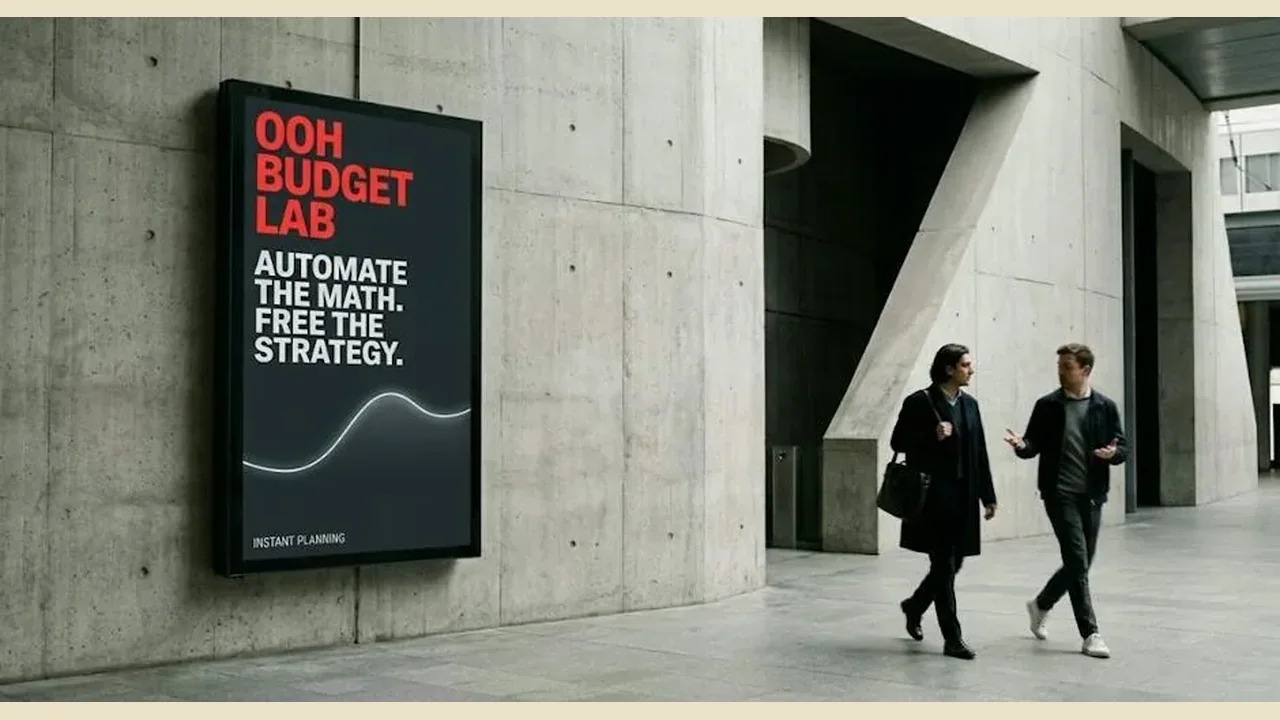
OOH Budget Lab launches instant format and budget tool to cut 48-hour planning waits
The OOH Budget Lab gives media planners instant, self-serve access to route-aligned audience metrics and format cost estimates, cutting what has often been a 48-hour wait for basic panel pricing and minimum spend thresholds. The tool, detailed in a Drum Network opinion piece, lets brands model budget scenarios for formats such as London Underground takeovers or regional AdVan campaigns at their own pace. A Gartner report cited in the article projects that by 2030, 75% of B2B buyers will prefer sales experiences that prioritize human interaction over AI. The authors say automating this basic math gives planners more time for audience movement patterns, dwell times and footfall analysis. Separate industry research cited in the piece links out-of-home campaigns to a 129% boost in search ROI and a 52% lift in social engagement.

AdMetr details bot-check method for display ads as ARIR logs up to 6.81% invalid traffic
AdMetr marketing executive Alexey Koltsov published a guide on November 20, 2026, showing e-commerce advertisers how to check display and video campaigns for bot traffic without switching the ads off. The method tracks invalid impressions by placement, using third-party pixels in Yandex Direct and VK Ads, then cross-references the data with Yandex Metrica visits and paid orders from a store's CMS or CRM. Koltsov argues that pausing a campaign for two weeks only measures total order volume mixed with seasonality and competitor activity, and tells advertisers nothing about which placements carried bad traffic. Industry benchmarks published by ARIR in March 2026 put average invalid traffic (IVT) at 5.27% of mobile banner impressions and 6.81% of desktop banner impressions for 2025, with viewable impressions ranging from 66% to 81%. Koltsov recommends excluding the worst placements from a flight and redirecting the freed budget to cleaner inventory.

Snapchat launches Easy Lens CLI for AI coding assistants like Claude Code
Easy Lens CLI, which Snapchat announced Wednesday, lets AR Lens creators build and publish effects using AI coding assistants such as Claude Code, Cursor and Codex. The tool extends Snapchat's existing Easy Lens product, which already generates Lenses from a single text prompt, by bringing that workflow into developers' own coding environments. Creators describe a Lens in plain language, and the AI assistant builds it with more than 100 AR building blocks and 50 AI asset generators, tests it, fixes errors and pushes previews to the creator's phone. Snapchat says the process can take a Web Lens game from idea to publication in a single day, with the AI assistant handling the code. Developers enrolled in the Lens+ Payouts program can earn money from Lenses built this way: Snapchat paid out $1.8 million to Lens+ creators last month. Easy Lens CLI runs on Mac, Windows and Linux.

YouTube's living room audience grows faster than the ad budgets chasing it
YouTube has built a sizable audience on television screens, with living room viewing now a major share of how people use the platform, according to exchange4media. Advertising budgets have been slower to shift, with agencies and advertisers still allocating much of their TV spend to traditional broadcast and cable deals. That leaves a gap between where YouTube viewing actually happens and where ad dollars currently go. Connected TV screens blur old boundaries between television and digital video, so a view that counts as digital may in fact replace a living room TV moment once bought through linear deals. Media planners now face a mismatch: audience behavior has moved to the big screen, and budget models have not caught up at the same speed. The practical fix is better measurement of where impressions land across screens, not assumptions carried over from the pre-streaming era.

Trusted Media Alliance unites TRUSTX, madSense, Shigotech, pushes QPM metric over CPM
Gal Turjeman, chairman of the Trusted Media Alliance, has outlined a new effort to combine three independent ad tech specialists under one umbrella: TRUSTX for publisher supply, madSense for AI-driven decisioning, and Shigotech for execution infrastructure. The alliance argues that programmatic advertising has built up what it calls trust debt: years of fragmented supply chains, hidden fees and low-quality inventory that AI-driven buying now risks compounding at machine speed. To address this, TMA proposes a new metric, quality per mille (QPM), calculated as the number of quality-qualified impressions divided by total impressions, multiplied by 1,000. The goal is to shift evaluation from cost per thousand impressions toward impression quality and contribution to business outcomes. Turjeman writes that AI should make media decisions explainable. Buyers should see what data informed a bid, an audience pick or a budget shift, and know who is accountable for it.

CTV draws half of shifting Indian linear TV budgets, up to 30% of mobile video: Affle
Affle CRO Gulrez Alam says Indian advertisers are shifting roughly half of migrating linear TV budgets and up to 30% of mobile video spend into Connected TV, despite a 2.5x to 3x CPM premium over standard mobile video. The draw is attention per impression: a CTV ad runs 30 seconds unskippable with sound on, watched by an average of 2.5 family members, with completion rates above 90%, against a three-second muted mobile glance with 35% to 40% completion. India has 68 million CTV households today, a base FICCI-EY projects will reach 90 million by 2028. CTV already takes 15% to 20% of digital video budgets, over 20% in auto, consumer durables and BFSI. Alam flags a structural problem: platforms including JioHotstar, SonyLIV, Zee5 and YouTube CTV hold separate user graphs, so cross-publisher frequency capping fails and up to a third of campaign budgets can be wasted on repeat exposure in one household.