Tilsim product

ValueMetrics

Server-side conversion attribution for e-commerce.

ValueMetrics delivers your store’s conversions to Meta and Google from the server, so the purchases browser tracking never manages to report are counted again.

3 Live
destinations

Server-side, with GDPR consent from day one

Meta Conversions API, Google Enhanced Conversions and Google’s Data Manager API, fed from the store’s server. Every send is logged — orders in, events out, failures and retries — and the results land in your own ad accounts, not only in our panel.

What it does

Your ad platforms stopped seeing part of your sales. This puts that part back.

Online stores lose 30–60% of their conversion signal to Safari ITP, ad blockers and cookie lifetime limits — a range, not a fixed number, and where your store sits inside it depends on your traffic. ValueMetrics takes the purchase where the browser cannot be interfered with — on the server — enriches it with the identifiers the platforms actually match on, and sends it to Meta and Google on one path.

Server-side delivery, one path

Purchases go to Meta Conversions API and Google Enhanced Conversions from our server, not from the visitor’s browser. Meta switched off its old Offline Conversions API on 14 May 2025, which leaves the Conversions API as the only server-side route into Meta.

Signal recovery, measured not assumed

The share of purchases that never reach the ad platform is the thing being fixed. We measure your starting point in the audit first, then show delivery and match rate per day — so the 30–60% gap becomes a number for your store rather than a slogan.

Event Match Quality 8+

EMQ is Meta’s own public score from 0 to 10 for how well your events match to real people. Below 6, Meta can zero out pixel attribution within 48 hours. ValueMetrics is built to reach 8+: complete match keys, strict normalisation, and _fbp / _fbc passed unhashed as Meta requires.

Deterministic identity, no guessing

Visitors are linked to purchases by exact email and phone, with multi-device joining through the email. Click identifiers are kept from the first touch rather than the last, so a retargeting click cannot quietly steal credit from the campaign that actually found the customer.

Deduplication against your pixel

The browser pixel and the server send carry the same event_id, so Meta collapses the pair into one purchase. Your pixel is not replaced, not disabled and not duplicated — Meta has been penalising double-counted purchases with lower data quality since 2025.

GDPR consent from day one

A built-in consent banner in EN / RO / RU, or your existing consent platform through a single call. Google Consent Mode V2 signals default to denied before any tag fires. Every decision is written to an append-only audit trail, and withdrawal is one line in your footer.

First-party cookie, honestly first-party

Tracking runs on a subdomain of your own domain pointed by CNAME at our own infrastructure — the condition Safari requires before a cookie may live 400 days instead of 7. A DNS audit at onboarding confirms the setup is genuinely first-party rather than a redirect wearing your domain.

Full funnel, not just the checkout

The tracker picks up the store’s existing GA4 data layer — product listings, product views, cart changes, checkout start, purchase and callback requests — so the same server path can carry the whole funnel, not only the final purchase.

A tracking audit before anything else

Part of the product, not extra scope: we review the whole stack — GTM, gtag, Meta Pixel, CAPI, the GA4 ↔ Ads link, conversion actions and value mapping — name what is broken and hand you a precise fix list. The decision to apply it stays with you.


How it works

From a DNS record to a conversion Meta and Google can actually match.

A tracking subdomain of your own domain

You add one CNAME record — something like track.yourshop.md — pointing at our infrastructure. This is what makes the cookie first-party in Safari’s eyes, and what keeps it alive for 400 days instead of the seven a third-party script gets.

One script line in the store’s head

No theme edits. The tracker wraps dataLayer.push instead of replacing it, so your Google Tag Manager, GA4, Meta Pixel and any other tag keep receiving every event exactly as before.

Consent decides what happens next

Before any tag fires, Consent Mode V2 signals are set to denied. Tracking starts only on acceptance — or on the signal from the consent platform you already use. If consent is refused, no personal identifiers leave the store, and the decision itself is recorded for the audit trail.

Orders arrive server-to-server

The purchase does not depend on a browser call surviving. The store platform delivers the order to us over a webhook, with API polling as the fallback — ad blockers and tracking prevention have nothing to intercept.

Identity resolution assembles the match keys

Email and phone are normalised per platform and hashed with SHA-256; click identifiers, device data and the store’s own customer id are gathered into one envelope built once and sent identically to both destinations. Nothing probabilistic is smuggled in as if it were an exact match.

Events go out with retries you never see

Sends are queued, rate-limited per destination and protected by a circuit breaker, so a Meta or Google outage delays delivery instead of losing it. Access tokens are refreshed and monitored automatically before they expire.

You check the result where it counts

In Meta Events Manager and Google Ads — the platforms’ own numbers, not ours. The ValueMetrics dashboard sits alongside them for integration health, delivery status and the honest match-rate breakdown.

Inside the product

Every send is visible, including the ones that failed.

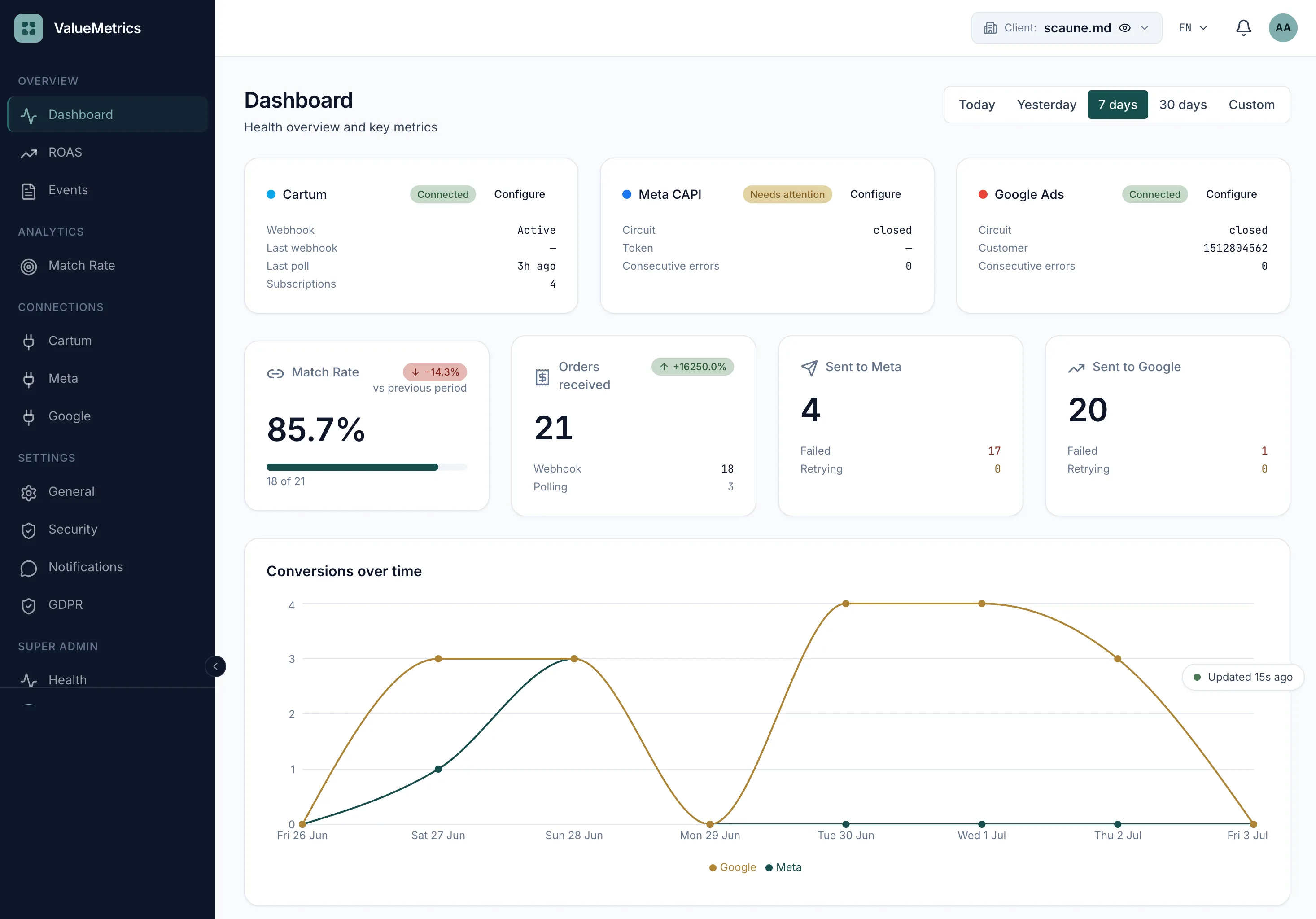
The dashboard is deliberately unflattering: connection state per destination, how many orders came in, how many events went out, how many failed and how many are retrying.

valuemetrics.tech · Dashboard
ValueMetrics dashboard: integration health for the store platform, Meta CAPI and Google Ads, match rate, orders received and events sent
Dashboard: integration health (store platform, Meta CAPI, Google Ads), match rate, orders received and event delivery to Meta and Google.
valuemetrics.tech · Events
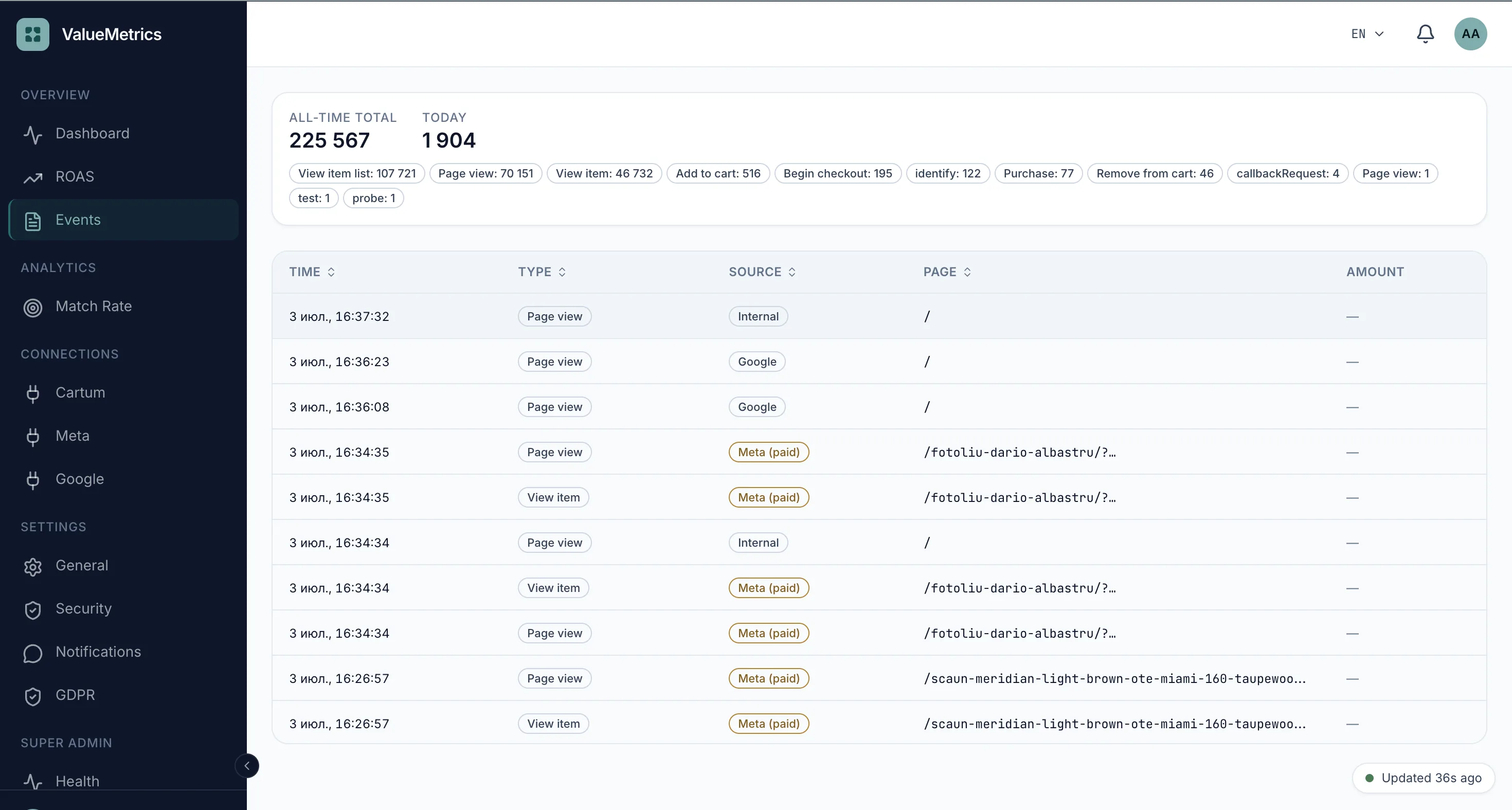
ValueMetrics live event stream with event types, sources and an all-time counter
Live event stream: types and sources (Google, Meta, internal) with an all-time counter.
Checkable by design

Numbers you can verify without taking our word for it.

Match rate in three columns

Most tools show one blended match-rate figure. We show three: exact match by email, exact match by phone, and probabilistic match by cookie. You see where the data genuinely exists and where it does not.

The score belongs to Meta

Event Match Quality is published by Meta inside your own Events Manager. It is a diagnostic we monitor and work to improve — and one you can read yourself, in an account we do not control.

Results land in your ad accounts

Recovered conversions appear in Meta and Google reporting, not only in our panel. If our dashboard and your Ads Manager disagree, your Ads Manager is the one that counts. Send-level logging — orders in, events out, failures and retries — is described in the Tilsim methodology alongside how the other two products are verified.

Methodology·How the numbers are verified
Scope

What is connected today — and what we will adapt.

We would rather name the boundary than sell a connector that does not exist.

Store platforms
Cartum and Horoshop stores are supported out of the box: order webhooks, API polling as a fallback, and the platform’s own GA4 data layer.
CartumHoroshop
Destinations
Meta Conversions API and Google Enhanced Conversions for conversions; Google’s Data Manager API for customer lists. Google closed customer-list uploads through the Ads API on 1 April 2026 — ValueMetrics was built on Data Manager from the start, so there is no migration debt to pay off.
Meta Conversions APIGoogle Enhanced ConversionsGoogle Data Manager API
Anything else
Another store platform, a CRM, or a different advertising or analytics system — including regional ones such as VK or Yandex: we adapt ValueMetrics to your system on request. That is a scoped piece of work agreed up front, not a ready-made integration waiting behind a switch.
Region and languages
Built and operated from Chișinău for stores in Moldova, Romania and the wider region. Consent banner and reporting in English, Romanian and Russian.
Plainly

What ValueMetrics is not.

Not a way to sell more

ValueMetrics does not create sales. It improves the accuracy with which sales that already happened are attributed — which is what lets the platforms’ bidding optimise on reality instead of on a fraction of it.

Not a replacement for your pixel

The pixel stays. The server path runs beside it and deduplicates by event_id. Nothing in your existing tag setup is switched off to make room for us.

Not people-tracking

We work with your store’s own purchase and funnel events under consent, for measurement. We do not build cross-site profiles and do not resell anyone’s data.

FAQ

Questions we get first.

Does ValueMetrics replace my Meta Pixel?

No. The pixel keeps running exactly as it does now. ValueMetrics sends the same conversions from the server with the same event_id, so Meta deduplicates the pair and counts one purchase, not two. The point is to fill the gap the browser cannot cover, not to swap one method for another.

What has to change on the store’s website?

One script line in the <head> and one DNS record for the tracking subdomain. There are no theme edits. The tracker wraps dataLayer.push rather than replacing it, so an existing Google Tag Manager, GA4, Meta Pixel or TikTok Pixel keeps receiving every event as before.

Will I really get 30–60% of my conversions back?

30–60% is the range of conversion signal online stores lose to Safari ITP, ad blockers and cookie limits — a description of the problem, not a guaranteed result. How much of it comes back depends on how much of your traffic is Safari and iOS, and on how many identifiers your checkout actually captures. The audit measures your starting point before anyone quotes a number.

How does this stay GDPR-compliant?

Consent is handled from the first visit: either with the built-in banner in English, Romanian and Russian, or through the consent platform you already run. Consent Mode V2 signals are set to denied before any tag fires and updated only on acceptance. Every decision is written to an append-only audit trail with timestamp, IP, user agent and banner version, and withdrawal is a single line in the store footer. Where consent is refused, personal identifiers are never sent.

Does it work with platforms other than Cartum and Horoshop?

Cartum and Horoshop stores are what is connected today, including order webhooks and the platform’s GA4 data layer. For a different store platform, a CRM, or another advertising or analytics system, we adapt to your system on request rather than list connectors we have not built.

How this is calculated

The arithmetic behind the product, explained step by step.

Next step

Let’s look at what your store is currently losing.

A demo starts with your own numbers: what the audit finds in your tracking stack, and how much of your purchase signal is reaching Meta and Google today.