The mechanics of TV buying and audience data — big guides, and the deep dives that support them.
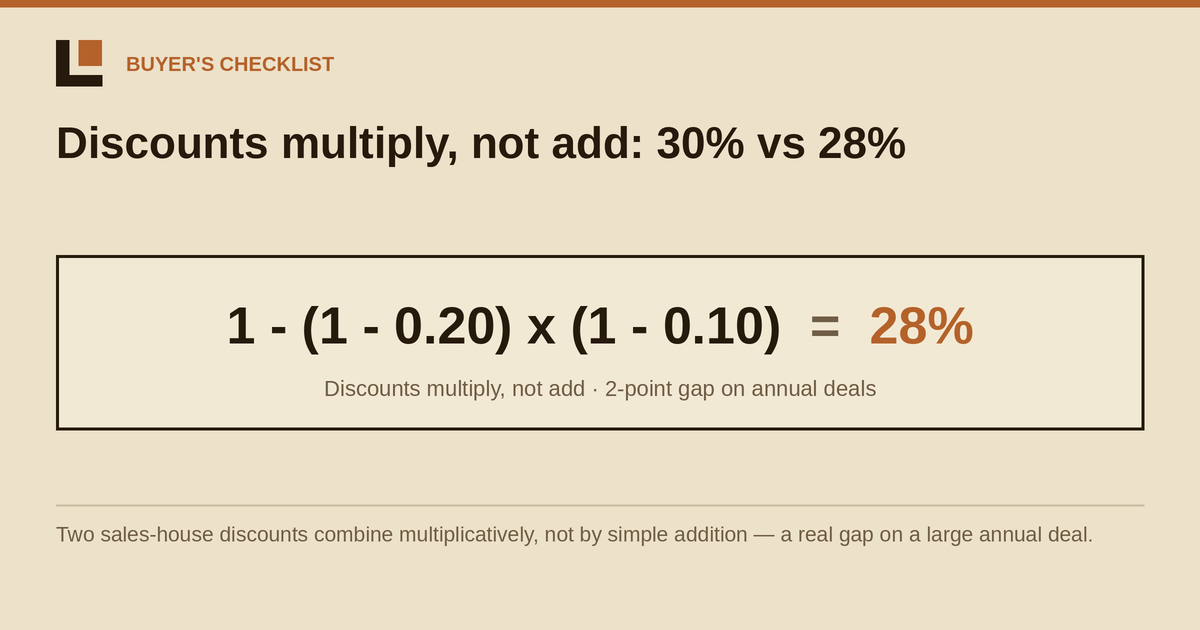
A buyer's checklist for comparing media planning tools: reproducibility, transparent calculation chains, local deal mechanics, raw data access, and post-buy proof.
Why a four-month flight can report three active months: a month counts when TRP actually lands in it. How flight shape and intensity decide, and why it matters.
Averaging daily TV ratings and dividing by the number of days biases the period figure. Here is why percentages need universe weighting — and how to check it.
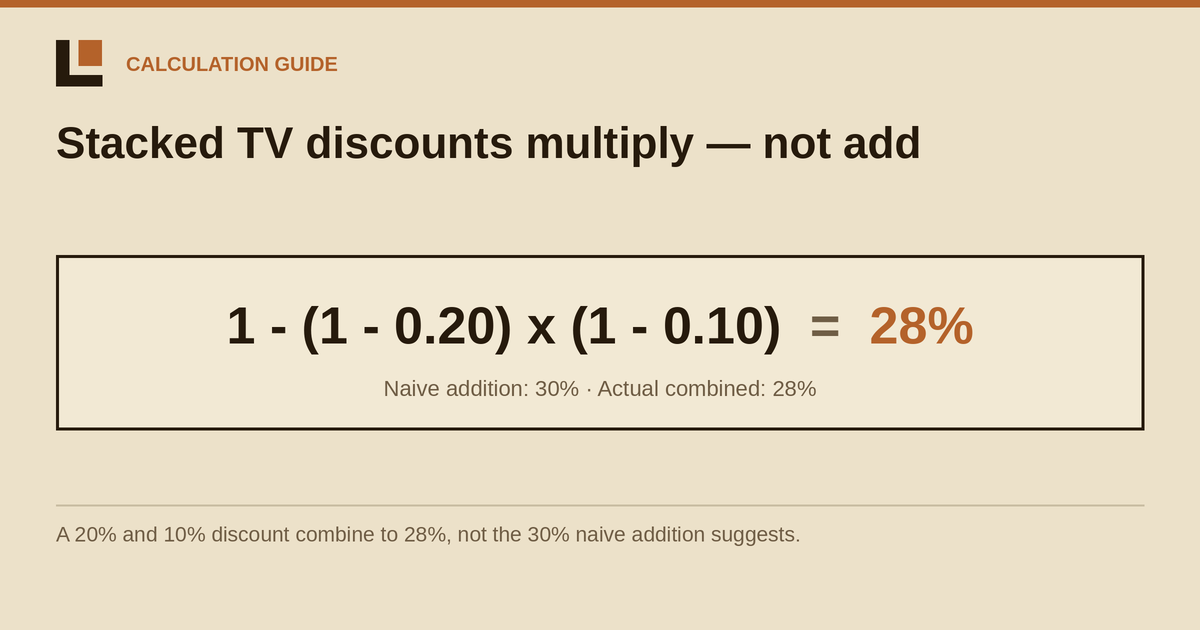
TV planning runs two conversions on one CPP chain: rating to budget, budget to rating. See the multipliers, the iteration loop, and where plans quietly break.
Prime-time uplift is a deal-level multiplier, not a line on prime inventory. See why 15% uplift with 55% off-prime money creates an 8.25% gap in TRP volume.
Volume discount depends on budget, budget depends on discount. See how the loop oscillates between tiers, and why the rule must be fixed before the deal.
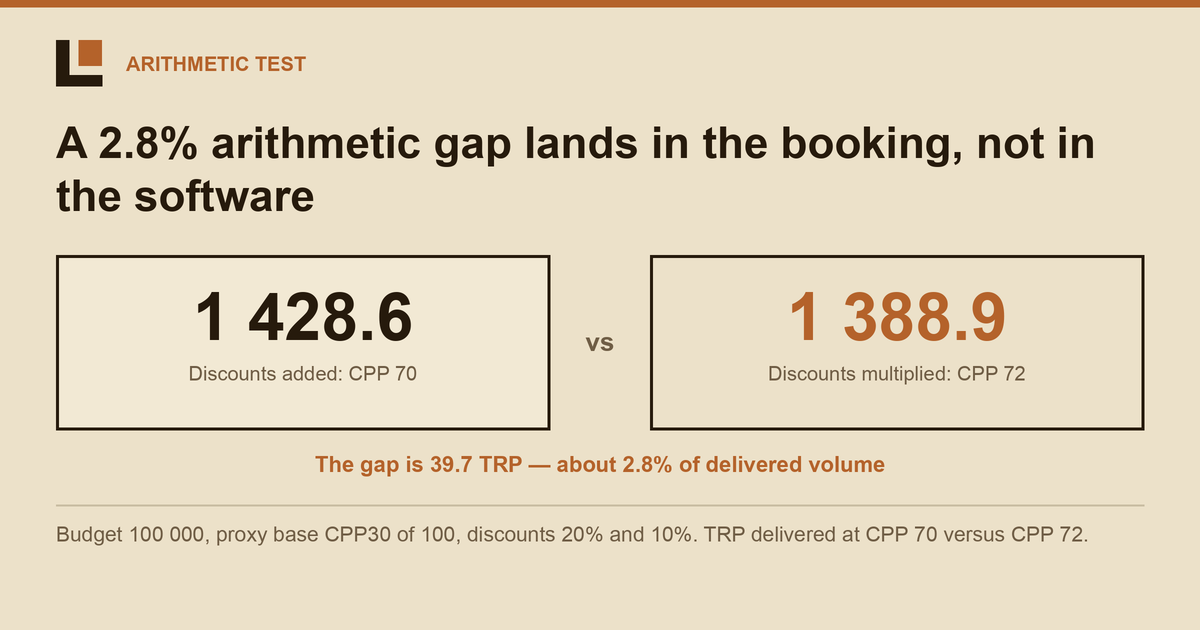
A practical test of media buying software for small agencies: calculation accuracy, raw audience data, post-buy reconciliation, and client-ready reporting.
Prime time share in TV buying changes with the unit: a 30% off-prime money split can become 36.4% of ratings after discount, then shift with affinity.
Compare a 15-second spot vs 30-second TRP: why a 0.6 duration coefficient is not half, how it changes spot counts, and when interpolation matters in practice.
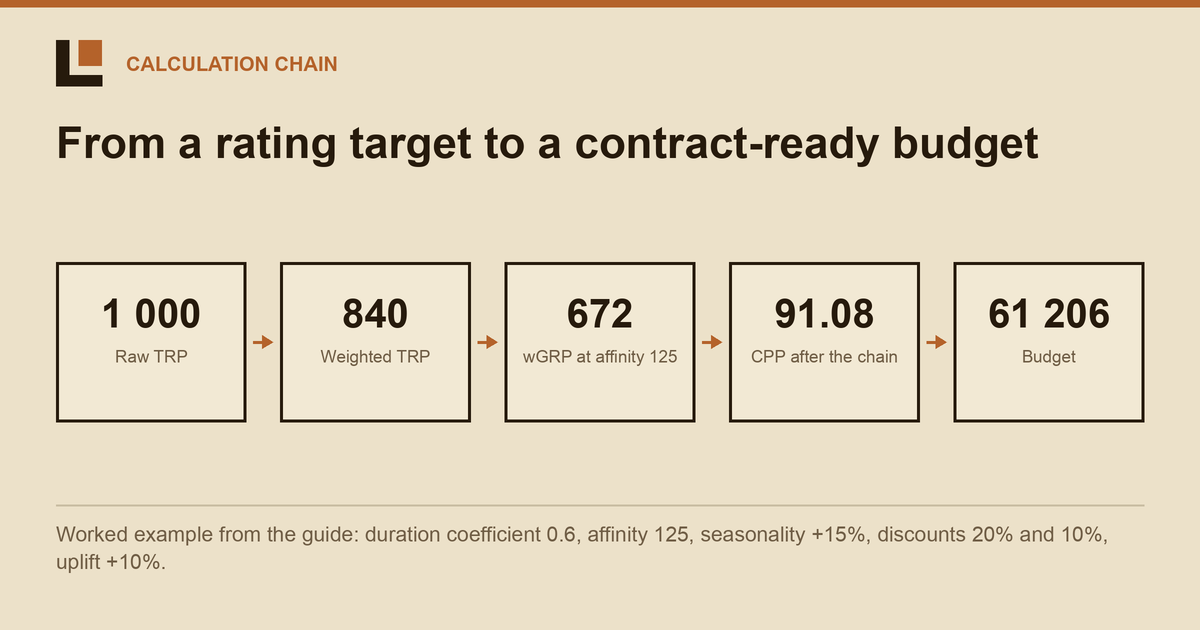
See the seven calculations media planning software must handle, from duration-weighted TRP and affinity through CPP, discount tiers, and execution layers.
Why do seller discounts multiply? See why 20% and 10% combine to 28%, how the error travels through CPP, and why discount tiers need iteration at boundaries.
TV budget discount tier iteration solves a circular deal: budget sets the discount, discount changes the budget, and boundary cases need a fixed rule.

