

15 second spot vs 30 second TRP: why half the time is not half the weight
The 30-second spot is the 1.0 reference. A 15-second spot follows the seller's duration grid, and that coefficient is usually nonlinear.
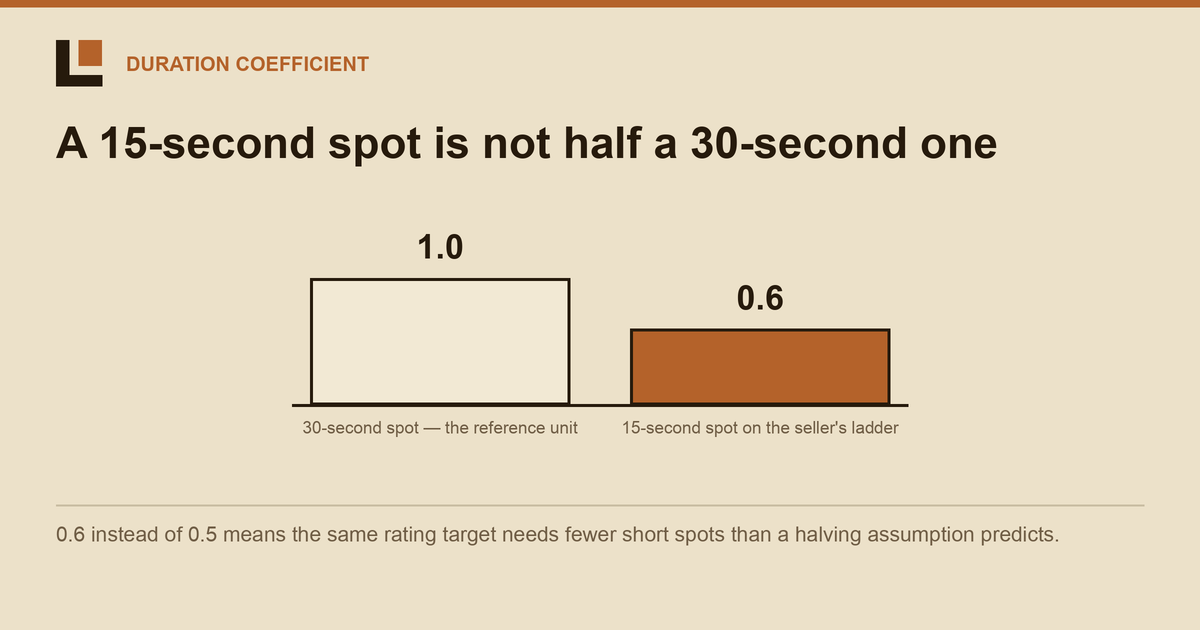
“Half as long, half the price” feels reasonable because it treats airtime as seconds on a ruler. Sellers price an inventory position and the audience attention attached to it, not seconds alone. A shorter creative saves airtime, but it does not reduce the value of entry into the break at the same rate.
That is why the duration grid is a pricing policy, not a geometric proportion. The tool should read the coefficient supplied by the seller, not invent one.
The denominator turns 0.1 into a large difference
30 seconds is the base at coefficient 1.0. Suppose the seller's grid assigns 15 seconds a coefficient of 0.6. A plan built for 100 TRP in 30-second weight needs:
The intuitive 0.5 coefficient would produce 100 ÷ 0.5 = 200 spots. Nothing about 200 looks obviously broken, yet it creates about a 20% budget discrepancy against the seller grid for the same weighted volume.
The tenth between 0.5 and 0.6 is not a small adjustment because the entire campaign volume is divided by it. Substitute the coefficients from your own seller grid and the exact result changes; the direction of the error does not.
Missing durations need interpolation, not a guess
A mix of 30- and 20-second creatives is common, while a seller grid may define nodes at 15 and 25 seconds. Choosing the nearest node or rounding toward a convenient answer replaces the curve with an assumption.
The safer method is lookup with interpolation between the nearest defined points. That reconstructs the intermediate coefficient from the grid's shape.
The consequences are asymmetric. Rounding up can overstate weight. Rounding down can understate the budget. Both errors remain plausible because the totals still reconcile with themselves.
The coefficient belongs in the chain exactly once
A duration coefficient is an input, not the planning system's opinion. The implementation has one strict job: apply it once, at the correct point, whether the calculation runs from budget to TRP or from TRP to budget.
Applying the coefficient in two different stages compounds the adjustment and makes the error difficult to locate after the fact. Reversibility is a useful built-in test: if forward and backward runs do not agree, the coefficient is missing, duplicated, or placed incorrectly.
TV Budgeting keeps that mechanism in one core. Parity against an agency reference Excel model remains within 0.01%; that figure reflects reproduction of the agreed logic, not special precision in the coefficient itself.
The practical rule
Take duration coefficients from the seller, interpolate only between defined nodes, apply the result once, and verify the plan in both directions. The disciplined answer may look less intuitive than “half the time, half the weight.” It will be the one that matches the commercial grid.
FAQ
Is a 15-second spot worth half a 30-second TRP?
Not automatically. Thirty seconds is the 1.0 reference, while the 15-second coefficient comes from the seller's nonlinear duration grid.
How many 15-second spots equal 100 TRP at a 0.6 coefficient?
About 167, because the target weight is divided by 0.6. A 0.5 assumption would incorrectly produce 200.
What if a spot length is missing from the grid?
Interpolate between the nearest defined nodes. Do not substitute the closest duration without modeling the interval.
How many times should the coefficient be applied?
Exactly once, at the duration-weighting stage. Forward and inverse calculations should return consistent answers.
This is exactly the maths TV Budgeting runs for you — both directions, TRP → budget and budget → TRP, with discount tiers resolved by iteration.
Request a demo →