

Prime time share TV buying guide: money and ratings tell different stories
A brief can put 30% of budget into off-prime while the rating report shows 36%. Both figures may be correct; price and affinity connect them.
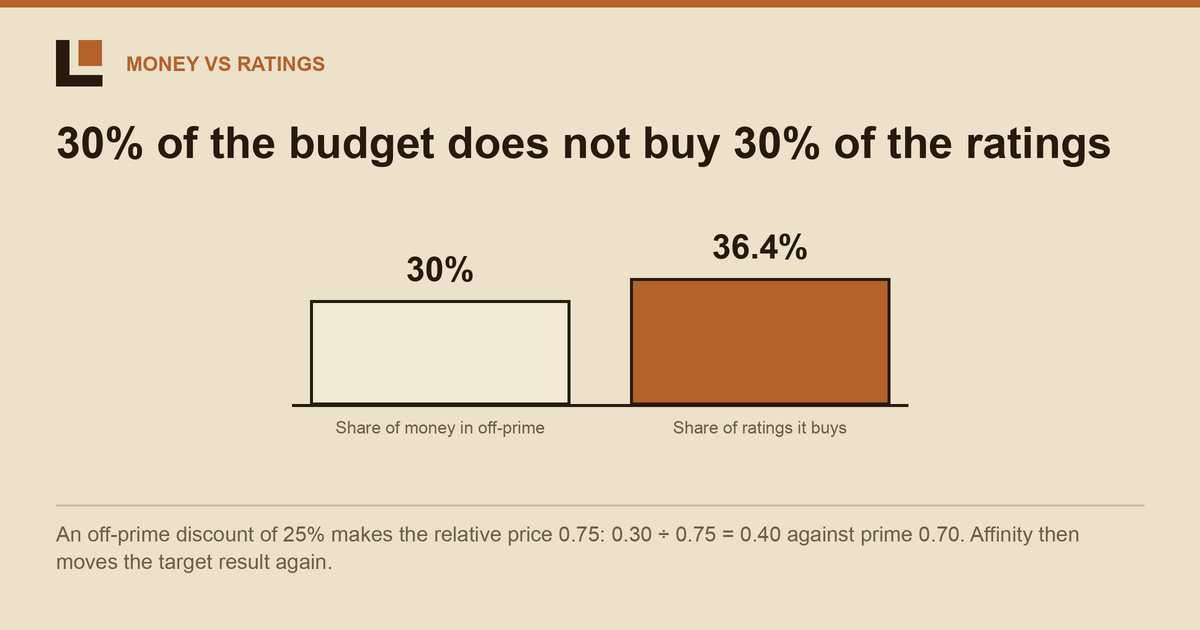
The familiar reconciliation problem begins with an unnamed unit. “30% off-prime” can mean 30% of money, 30% of GRP, or 30% of TRP for a particular audience. Those are not interchangeable descriptions.
Why 30% of money can buy 36.4% of ratings
We can show the mechanism with relative units; no real price data is needed. Let total budget equal 100 and allocate 30% to off-prime. With a 25% off-prime discount, one rating point there has a relative price of 0.75 versus 1.00 in prime.
Off-prime: 30 ÷ 0.75 = 40 relative rating units.
Total: 70 + 40 = 110.
Off-prime share: 40 ÷ 110 = 36.4%.
The difference is not rounding. A discount buys more rating weight for the same amount. Once two dayparts have different relative prices, their money shares and rating shares cannot remain equal. A deeper off-prime discount widens the gap.
The same logic works in either direction: when a money allocation becomes rating weight, the cheaper block gains share.
Affinity creates a second conversion
The ratings bought against a target are wTRP, while general-universe weight is wGRP. Affinity connects them:
If the target watches off-prime more densely than prime, off-prime's contribution to target ratings grows again on top of the price effect. If target density is lower in off-prime, affinity gives part of that apparent advantage back.
This is why the same money split applied to two target groups can produce two different TRP splits. Nothing is wrong with the audience data. Each target has its own relationship to the dayparts.
One deal, three valid shares
“Off-prime share” is incomplete unless the unit and audience are named. The same deal can be represented by three correct numbers:
Each answers a different question. Trouble starts only when a money share is compared directly with a rating share as if both measured the same thing.
Make the basis explicit before negotiating
When seller and agency disagree about off-prime, the first move is not another calculation. Agree on the unit and target. The discrepancy will either disappear or become a real commercial question worth discussing.
Then expose the conversion. TV Budgeting accepts off-prime as a money share and shows the move into ratings using the off-prime discount and affinity. Keeping this as a visible step matters: a final total without its assumptions invites both parties to build a different story around the same number.
FAQ
Is off-prime share measured in money or ratings?
It can be either, but the unit must be stated. Commercial briefs commonly set a money share; reports may show GRP or target-specific TRP share.
Why does a 30% off-prime budget become 36.4% of ratings?
At a 25% discount, off-prime's relative price is 0.75. Thirty budget units buy 40 rating units, while 70 prime units buy 70, making off-prime 40 of 110, or 36.4%.
How does affinity change the split?
Affinity converts between target and total ratings. Higher off-prime affinity raises its target-rating contribution; lower affinity reduces it.
What should be fixed before plan reconciliation?
Name the unit—money, GRP, or TRP—and the target audience. Only then compare the shares.
This is exactly the maths TV Budgeting runs for you — both directions, TRP → budget and budget → TRP, with discount tiers resolved by iteration.
Request a demo →