

Active months come from the calculation, not the calendar
A planner ticks four months, the report shows three. Nothing went missing: an active month is one that actually received TRP.
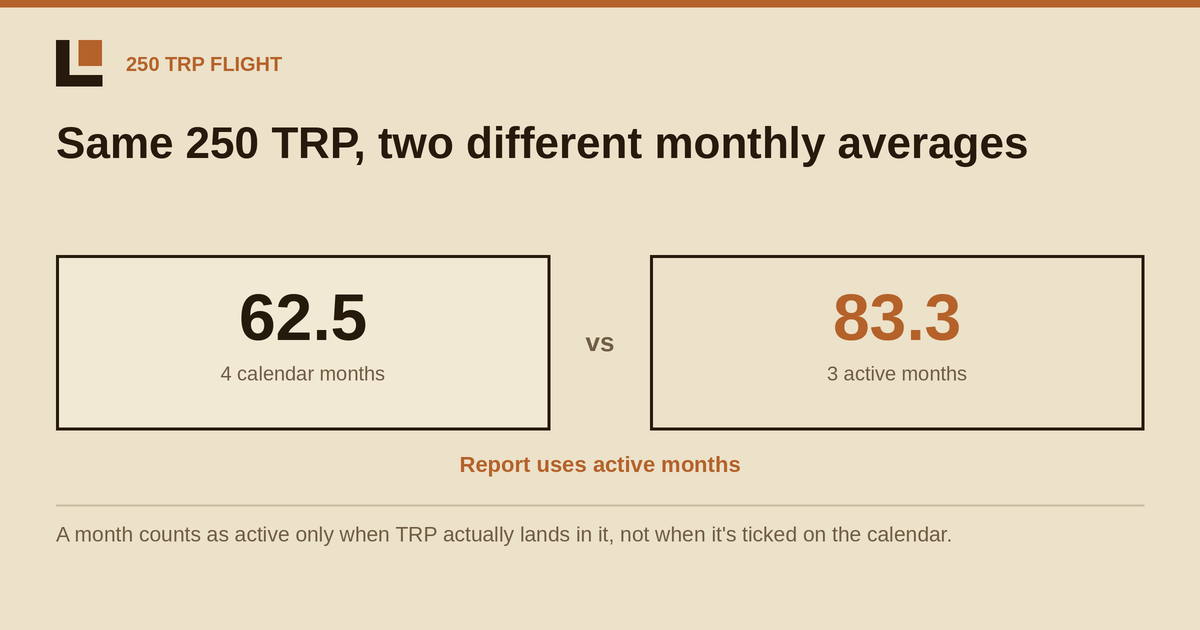
An active month is a month that received TRP once the calculation ran — not a month someone ticked on the input calendar. The two definitions agree in the middle of a flight and split at its tails. That split is where the "system lost a month" question comes from, and it decides what counts as a month of airtime, which makes it rather more than an interface detail.
A calendar tick is intent, not placement
Ticking a month says: I want weight here. Whether weight arrives depends on the curve that distributes it. The engine ships 17 flight-shape templates — Flat, Front-Loaded, Mid-Peak, Crescendo among them — and 5 intensity levels ranging from 0.5 to 1.7. Together they set the curve TRP follows across the period.
Front-Loaded at low intensity pushes the bulk of the weight into the opening and lets the curve fall away. By the final month it can reach zero. Nothing was dropped or forgotten; that month simply has no placement to report, so it stays out of the breakdown.
Why one definition changes every derived number
Take a 250 TRP plan. Split it across four calendar months and the monthly average is 62.5 TRP. Split it across the three months that actually carry weight and it is 83.3. Same plan, two lines in a deck, roughly a third apart. The question worth asking is which number describes the air.
| Basis | Months | Monthly average of 250 TRP |
|---|---|---|
| Calendar ticks (intent) | 4 | 62.5 TRP |
| Months that received TRP | 3 | 83.3 TRP |
We chose the second. Active months come out of the calculation itself, and monthly averages, budget breakdown and period splits all read from that same source. One source keeps those blocks locked together: there is no state where the average covers four months while the budget spreads over three. Keep two sources — the calendar tick and the actual TRP — and they desynchronize sooner or later, usually in a client meeting and not in a review.
Part of a wider rule: the engine does not complete your intent
This is one case of how the core behaves generally. It does not guess what the planner meant. If a value is missing, the calculation stops and names the specific field. If a value is present, that value is what gets computed. No silent substitutions, no "sensible" defaults. What you see is what was calculated.
The payoff is traceability: any figure in the report walks back to its input, a month later, by someone who never built the plan. The cost is that the report sometimes argues with memory. A planner recalls ticking four months and sees three. That is the moment to inspect the flight shape and the intensity level — the report is only showing the consequence of the chosen curve.
What should you check when choosing a tool?
Details like this rarely reach feature comparison tables. "Monthly breakdown" sits on every list; how a month is defined is an implementation question — and the implementation is what moves the number in the presentation. We take the comparison logic further in Media planning tools: what to compare before you buy, applying the same principle more broadly: read where each number comes from, not the list of fields.
So, briefly. A calendar tick describes intent, realized TRP describes placement, and the report should carry the second. If monthly averages in your process are computed over ticked months, reconcile them once against the actual weight distribution. The gap at the tails of a flight is usually wider than you expect.
On measurement vocabulary and how ratings and TRP are defined, see Nielsen's published methodology material and the Media Rating Council. In TV Budgeting we reproduce Nielsen's numbers, we do not reinterpret them; and CPP inside the engine is a planning proxy, not a contracted price.
FAQ
Why does my report show fewer months than I selected?
Because a month is counted as active only if TRP landed in it. A front-loaded curve at low intensity can leave the last month at zero weight, so it does not enter the breakdown.
What decides whether a month receives weight?
The flight shape template and the intensity level. There are 17 shapes — Flat, Front-Loaded, Mid-Peak, Crescendo and others — and 5 intensity levels from 0.5 to 1.7; together they set the curve TRP follows.
How much can the choice of basis change a monthly average?
For a 250 TRP plan, four calendar months give 62.5 TRP per month and three active months give 83.3 — about a third apart.
Can I force the last month to stay active?
Not by re-ticking the calendar. Change the flight shape or raise the intensity level so the curve still carries weight at the tail, then recalculate.
Flight shape, intensity, and the active months that follow from them are all visible in TV Budgeting — every monthly figure traceable back to the curve that produced it.
Request a demo →