

When a TV budget gets stuck between two discount tiers
A volume discount is set by the contract total, and the contract total is calculated with that discount already applied. Sometimes the two never agree.
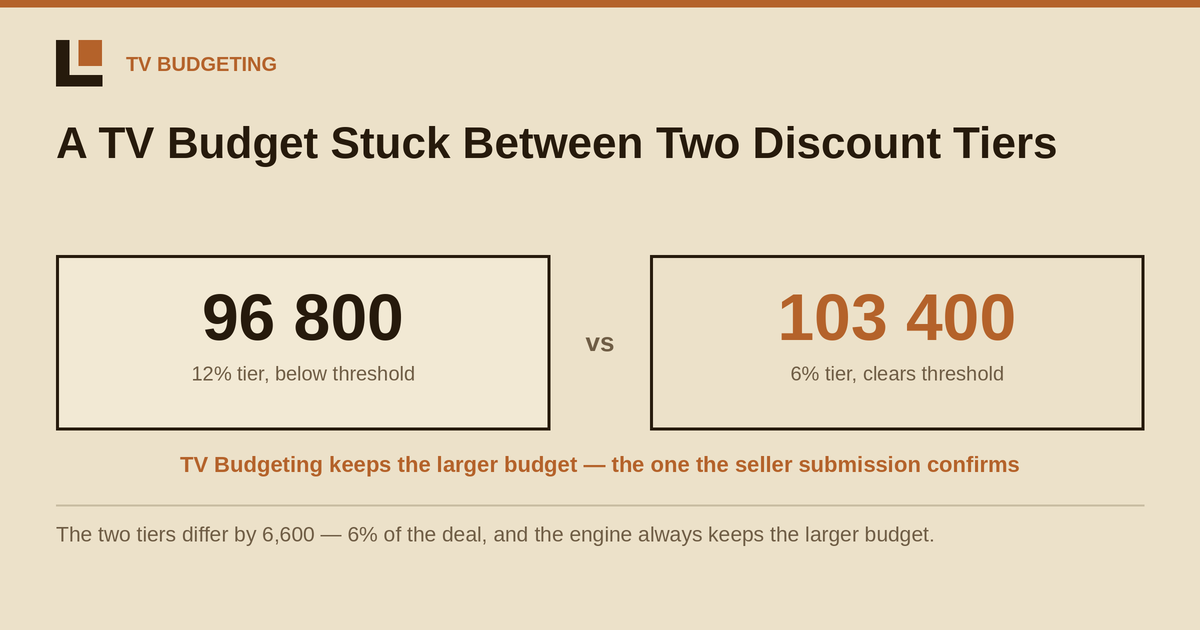
A discount-tier loop happens when the volume discount is keyed to the budget and the budget is computed net of that same discount. Usually the result lands well inside one tier and nobody notices. Push the plan close to a threshold and the calculation starts going in circles.
What the oscillation looks like
The numbers below are illustrative; the mechanism is real. An undiscounted plan costs 110,000. The "from 100,000" tier grants 12%, so the budget drops to 96,800 — which no longer clears the threshold. Down a tier to 6%, and the budget becomes 103,400 — over the threshold again, in line for 12% again. Round it goes.
| Tier applied | Resulting budget | Clears 100,000? |
|---|---|---|
| None | 110,000 | Yes |
| 12% | 96,800 | No |
| 6% | 103,400 | Yes |
The cause is structural. The step between tiers is larger than the plan's headroom above the threshold, so the deeper discount knocks the plan out of the very category that granted it. Nothing is wrong with the inputs. This combination of plan price and discount grid has no single self-consistent answer.
Why iteration alone doesn't finish the job
In TV Budgeting the budget–discount loop converges by iteration: recalculate until the number stops moving. For the overwhelming majority of deals that's enough. The calculation finds its resting point in a few passes and stops there.
A few deals have no resting point, only a stable swing between two tiers. Run the iteration a thousand times and the values keep alternating. Something has to break the loop deliberately, so we take the larger budget: 103,400, with the smaller discount.
Why the larger budget, not the smaller one?
The choice follows from how a tier gets confirmed in practice. The tier is set by the budget declared to the seller in the Shop List. If the plan rests on 96,800, a submission at that level fails to clear the threshold and the 12% is never confirmed. The gap then gets closed mid-campaign by cutting airtime volume — sacrificing exactly what the budget was calculated to buy.
The lower boundary only looks better on paper: an attractive number in the deck, a shortfall in the actual placement. The upper boundary gives a more modest figure that survives contact with the seller's discount grid.
Scale matters here too. The gap between the two tiers is 6,600 — 6% of the deal. On a single flight that's a debatable line item, easily settled in negotiation. On an annual contract it recurs at every recalculation and stops being a rounding difference.
Why this is a rule, not a judgment call
Which branch you take matters less than what decides it. When a person decides under time pressure, the outcome depends on who ran the numbers and what mood the client was in. Written into the engine, identical inputs give an identical result every time — and one you can still explain to a client six months later, when nobody remembers the details.
So we document boundary cases like this one explicitly and keep them out of anyone's discretion. Media planning in TV Planner and deal calculation in TV Budgeting work against the same thresholds and constraints; the full target rating → budget → rating round trip is covered in this week's guide, TV Planning: From Target Rating to Budget — and Back Again.
The takeaway
Budget–discount loops aren't exotic. They're a normal property of stepped discount grids, and no amount of careful arithmetic removes them. Where no solution exists, you need a selection rule fixed in advance. Ours takes the larger budget with the smaller discount, because that's the one the seller submission actually confirms — and the one that reaches air without volume being cut.
For background on how the market treats stepped volume terms and negotiated deal structures, see the IAB's media buying guidelines. For audience measurement inputs, we reproduce Nielsen's numbers; we don't restate them.
FAQ
What causes a budget to oscillate between two discount tiers?
The discount step between tiers is larger than the plan's headroom above the threshold. The deeper discount pushes the budget below the boundary that granted it, and the shallower one pushes it back above.
Can more iterations resolve the oscillation?
No. Iteration converges when a resting point exists. In an oscillating case the two values simply alternate forever, so a fixed selection rule is required.
Why does TV Budgeting pick the larger budget?
Because the tier is confirmed by the budget declared to the seller. The lower figure fails the threshold at submission, and the shortfall gets closed later by cutting airtime volume.
How big is the difference in practice?
In the worked example, 6,600 — about 6% of the deal. Negotiable on one flight; material on an annual contract, where it recurs at every recalculation.
Boundary cases like this are resolved deterministically inside TV Budgeting — the same inputs give the same tier, the same budget, and the same explanation six months later.
Request a demo →