

Prime-time uplift prices the whole deal, not just prime
The field looks like a surcharge on prime placements. It multiplies the entire deal, and the difference comes out of your ratings, never your invoice.
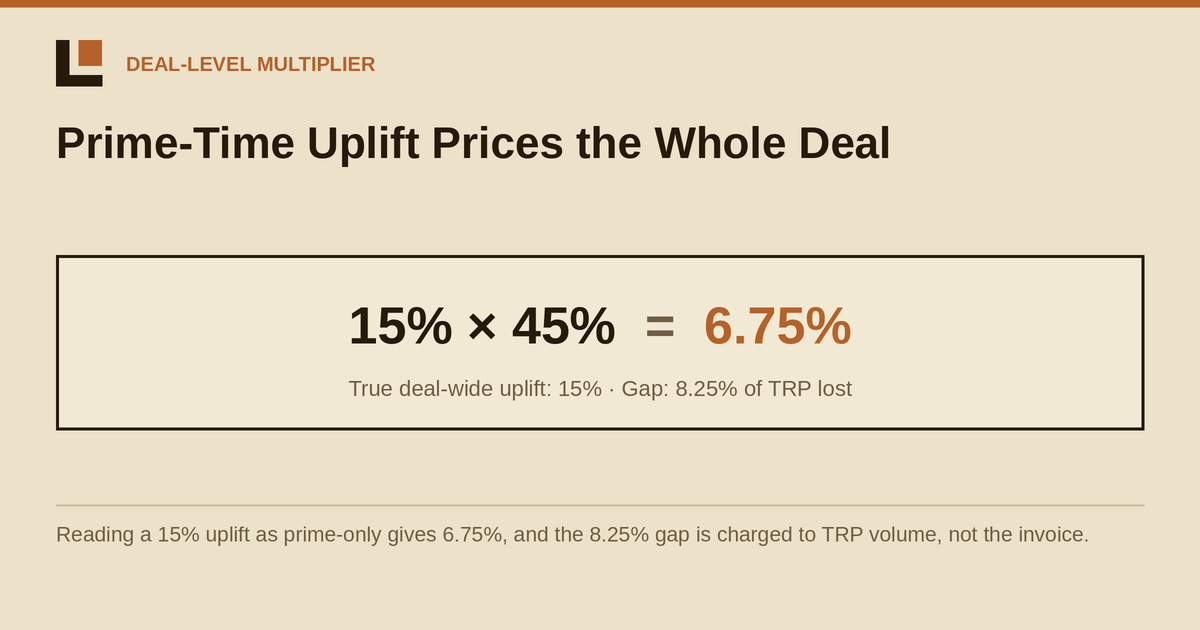
Prime-time uplift is a deal-level multiplier. It lands on the final CPP after base price, seasonality, and discounts are resolved, and it raises the cost of every rating point in the buy — prime and off-prime alike. Its position in the chain decides that. Its name has nothing to do with it.
Almost everyone opening the calculation for the first time reads the field the other way. That misreading is measured in money, and in ratings that never arrive.
Where the uplift sits in the CPP chain
The final CPP is a sequence of multipliers:
The uplift comes last. That position is the whole story. It never touches a single placement line or the prime slice of the inventory; it acts on a price already assembled from base, seasonality, and discounts. From there it passes through the entire volume, prime and off-prime, with no exceptions. A parameter that sits at deal level works at deal level, whatever its label implies.
What does the misreading actually cost?
Take a 15% uplift and off-prime set at 55% of the money.
| Uplift read as prime-only | 15% × 45% = 6.75% |
| Uplift as a deal multiplier | 15% |
| Gap between the two readings | 8.25% |
On a deal of 100,000, that gap is 8,250. Here is the unpleasant part: on a fixed budget those percentage points never show up as an extra invoice. They come out of volume. You finish roughly that same percentage short on TRP, because every rating point cost more than the planner's mental model assumed.
The error never announces itself. The budget reconciles, every line adds up, and only the result comes in smaller than expected — by which point the plan is signed.
Why we didn't hide this behind convenient defaults
The temptation was real: rename the field, give it a default, quietly spread the uplift across inventory slices. We passed. The system shows the formula in full and substitutes nothing. Leave the field empty and the calculation fails, naming that field. It will not assume zero and carry on.
That is deliberate. A silent zero looks like everything is fine and rides into the final budget unnoticed. An error naming the field costs thirty seconds of attention and never reaches the client. What you see is what was computed.
What if the premium really does apply only to prime?
That arrangement exists, and it is entirely normal. It just belongs somewhere else — in the off-prime structure, which in TV Budgeting is defined as a share of money and converted into a share of ratings through affinity and the OT discount.
Which has a consequence worth stating plainly: you cannot split the deal in half by eye. Money share and ratings share are different quantities, and the conversion between them is not linear. So 55% of money on off-prime does not mean 55% of ratings, and a premium notionally covering "45% of the volume" never resolves into a clean percentage off the total price.
How the same plan reads from the budget side and from the ratings side is the subject of this week's long guide, TV Planning: From Target Rating to Budget — and Back Again, which also walks the reverse path from a target TRP back to money.
One caveat: CPP in our engine is a calculated proxy. No real rate cards sit in the data, so the figures above are arithmetic, not market value. None of that changes the arithmetic of the uplift. The premium is either a deal multiplier or a line item on a specific placement. There is no third option.
The takeaway
Prime-time uplift sets what every rating point across the deal will cost. Read that one field two ways and the example above swings by 8.25%, and on a fixed budget the swing is charged to volume, never to the invoice. So we keep the formula open. Where a parameter sits in the chain of multipliers should be visible to whoever signs off on the budget, not just to whoever filled in the fields.
FAQ
Does prime-time uplift apply only to prime-time spots?
No. It is the last multiplier on the final CPP, so it applies to the whole deal — prime and off-prime — regardless of how the inventory is split.
How much does the prime-only misreading cost?
With a 15% uplift and off-prime at 55% of money, the prime-only reading gives 15% × 45% = 6.75% against a true 15%. The gap is 8.25% — 8,250 on a deal of 100,000.
Why does the shortfall show up in TRP rather than in the budget?
On a fixed budget nothing is added to the invoice. Each rating point simply costs more than assumed, so you buy roughly that same percentage less volume.
Where should a premium that genuinely applies only to prime go?
Into the off-prime structure, which is set as a share of money and converted to a share of ratings via affinity and the OT discount — not into the prime-time uplift field.
Why doesn't an empty uplift field default to zero?
Because a silent zero reaches the final budget unnoticed. The calculation fails and names the missing field instead, which costs thirty seconds and never reaches the client.
TV Budgeting keeps every multiplier visible — seasonality, combined discount, uplift — so you can see exactly where each parameter enters the price of a rating point.
Request a demo →