

Digest of the day
September 2, 2026
10 stories
Adelaide brought pre-bid attention scoring to Amazon's DSP, while X's Original Content Rewards Program launches Sept. 7 with a 500,000-impression bar for creators. In Russia, GPM Reklama and OMD's TNT show for Papa Mozhet reached 12 million viewers and lifted sales 10%, while Rutube will pay Shorts creators for ad views after a 1.5 billion ruble payout in 2025.
The Weather Company ties ad targeting to weather-driven emotions with Neuro-Insight
Shannon Ferguson, The Weather Company's director of measurement, has spent about a year testing neuroanalytics data with research firm Neuro-Insight to map how forecasts affect the brain's response to ads on The Weather Channel app. The research shows which neural pathways activate when users see specific ad and forecast combinations, and TWC now applies those patterns through what it calls emotional targeting, matching ad strategy to a user's mindset across awareness, consideration and purchase. A recent campaign with S.C. Johnson varied creative by region based on local weather conditions. TWC runs a vendor certification process that screens measurement vendors for CCPA and GDPR compliance, and it leans on outside measurement partners to validate the lift its campaigns drive for clients. The company is also building internal AI agents that draft campaign reports and recommendations for its measurement team to review.

TelevisionStats.com uses Wikipedia pageviews to rank TV show popularity
House of the Dragon topped a list of the most popular TV shows in the U.S. for the third week of July, according to TelevisionStats.com, which scored the HBO Max series at 46.7 out of 100. The site builds its Attention Score primarily from Wikipedia pageviews, tracking how many people read a title's Wikipedia pages each day. TelevisionStats.com then layers in additional signals: the volume of new reviews, growth in fan communities and social followings, and torrent download demand, each weighted for reliability. Scores of 20 to 49 count as 'high,' 50 to 79 as 'excellent,' and 80 or above marks a 'phenomenon.' Netflix's I Will Find You placed second at 43.9, followed by Peacock's Ride Or Die at 40.9. David Mancherje, who also founded retail tracker Shoop.com, created the methodology.

Indian media buyers shift CTV budgets back to mobile as attribution gap persists
Media buyers in India are shifting a portion of connected TV ad budgets back to mobile, a pullback driven by weak co-viewing attention data and CTV's immature measurement infrastructure, according to Agency Reporter. Eyes-on-screen studies from measurement partners working with Indian streaming platforms show viewers frequently watch CTV ads while touching or scrolling a phone, undermining the co-viewing case that CTV pitches relied on. Categories with short conversion windows, including quick commerce, fintech and D2C brands with strong app ecosystems, have moved the most money toward mobile, since mobile's attribution tools give finance teams a clearer line from spend to result than CTV currently offers. Automotive and real estate advertisers, whose purchase cycles run for weeks, have held back from the shift. Agencies that still run separate CTV and mobile teams are losing reallocated budget to competitors that have merged the two desks into a single planning function.
Case IdaProject: AI could cut developer layout-rendering costs by 50-60% at scale
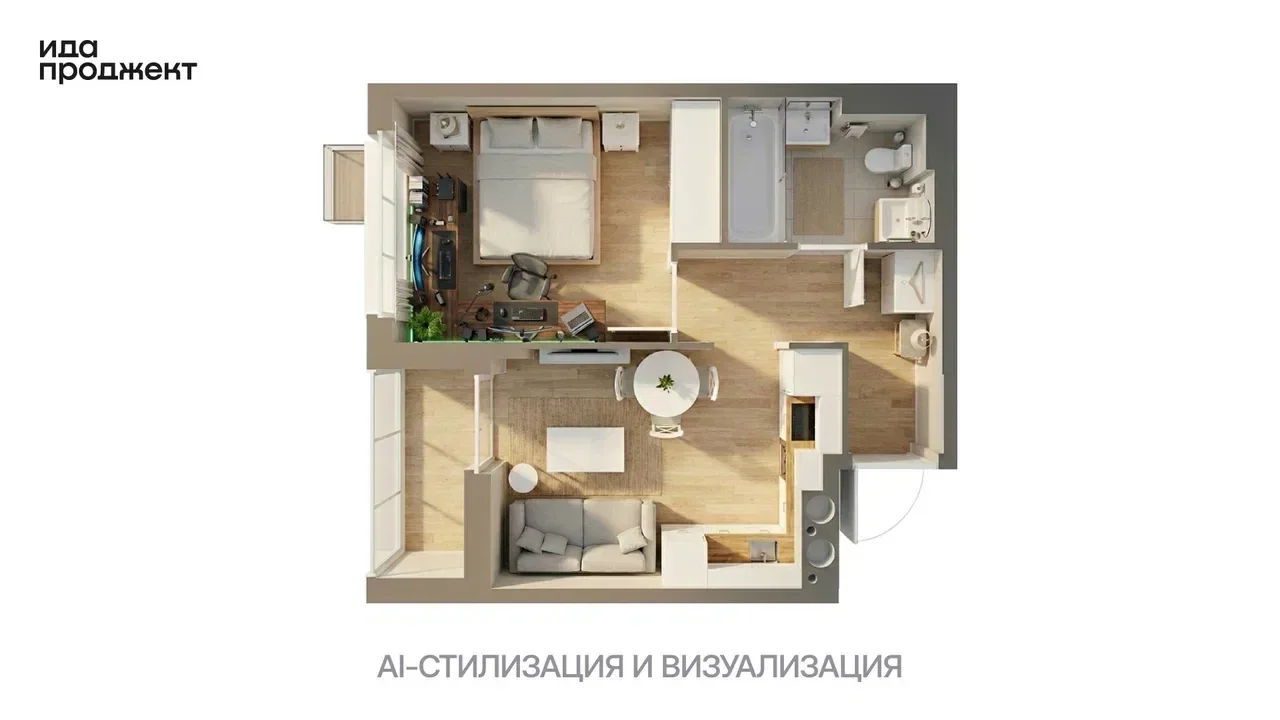
A twelve-person copywriting team at one developer spent three to four months writing descriptions for 50 residential projects, not counting individual apartment listings, according to IdaProject design and product director Pavel Gavrichenko. Writing a single floor-plan description takes about two hours, plus another two to three hours for internal approvals, adding up to six hours per layout, and when there are hundreds of layouts the cycle stretches to five or six months. IdaProject built an AI system that reads architectural files, analyzes walls, room layout and door openings, and drafts a listing description in 20 seconds, after which a product specialist checks it for accuracy and brand tone. Rendering and describing a single floor plan the classical way costs 1,500 to 4,000 rubles, IdaProject says. For one top-25 ERZ developer redrawing 20,000 floor plans, classical-approach contractor quotes were what the company calls astronomical, and IdaProject projects AI could cut that total by 50 to 60 percent.
Adelaide brings pre-bid attention scoring to Amazon's DSP, tiering inventory by quality
Adelaide, a data and analytics firm that specializes in attention-based metrics, launched pre-bid targeting tools inside Amazon's demand-side platform on Tuesday. The integration includes two products, one of which, "AU Media Quality," sorts ad inventory into three tiers, high, average and low, based on predicted attention quality. Media buyers can now prioritize the high tier or filter out the low tier before they place a bid, across display, online video and connected TV. Buyers could previously see attention-quality data only after a campaign ran and the budget had already been spent. Adelaide CEO and co-founder Marc Guldimann said, "Advertisers shouldn't have to wait until after a campaign runs to know whether their spend went toward high-attention media." Nestle Health Science's Benjamin Lichtman said his company is still determining whether attention is a valid proxy for media quality and high-lifetime value (LTV) audiences.

Hummingbirds launches receipt-level attribution to track creators' in-store sales
Creator marketing platform Hummingbirds launched a receipt-level attribution feature this summer to credit local creators for in-store purchases. Consumers upload their receipts to the Hummingbirds platform and get cash back immediately, while the creators who recommended the products earn affiliate commission on each sale. CEO and co-founder Emily Steele says the feature addresses a mismatch: 83% of all retail dollars are still spent in person, yet in-store purchases rarely link back to the creator who drove them, leaving creators with little incentive to send followers into physical stores. Hummingbirds builds its model around small-scale, local creators, on the theory that a recommendation from a neighbor or a volleyball teammate carries more weight than one from a stranger. Steele says the company set out to close the gap between where retail dollars are spent and where creator campaigns focus their efforts.

X launches Original Content Rewards Program on Sept. 7, replacing revenue sharing
Starting Sept. 7, X will require creators to hold a paid X subscription and log 500,000 home timeline impressions from verified users within 90 days to join its new Original Content Rewards Program, which replaces the platform's Creator Revenue Sharing scheme. Allegra Jacchia, creator product lead at SpaceXAI, X's parent company, told Digiday the change aims to support creators producing original work, saying, "The revenue share program had run its course." Other platforms are adjusting creator terms too. YouTube will double its Partner Program thresholds in February 2027, requiring 8,000 long-form watch hours and 20 million Shorts views, plus a rolling minimum of 10 million Shorts views every 90 days to keep earning. TikTok charges a 9% commission on affiliate sales in the United States, and a June 2026 Stack Influence analysis of disclosed creator examples found payouts ranging from $362 to $1,035 per 1 million qualified views.

Case GPM Reklama and OMD's TNT show for Papa Mozhet reaches 12M viewers, sales up 10%
Russian meat-processing brand Papa Mozhet ran a sponsored inter-program show on TNT, called Gotovim Vmeste s Papa Mozhet, produced with media seller GPM Reklama and agency group OMD. The 90-second episodes showed brand ambassador Valera and his daughter Mira cooking simple dishes from the product line, and ten premiere episodes plus 20 reruns aired over three months. The campaign reached 12 million viewers and lifted sales 10% among viewers who saw the show, compared with a control group that saw no sponsored content. GPM Reklama's Lukerya Rodionova said the sponsorship "became an example of how a proprietary show format can fit naturally into the family context of consumption." Papa Mozhet's marketing director Andrey Azhimov said the brand chose the inter-program slot deliberately, to sit outside the standard ad clutter where competing messages dilute attention. The channel's core audience of men and women aged 25 to 49 matched the brand's target group.

Rutube to pay Shorts creators for ad views after 1.5 billion ruble payout in 2025
Egor Velikoglo, Rutube's director of author content, said the video platform will open ad monetization to creators of short vertical videos in the second half of 2026. The Shorts section currently hosts more than 40,000 authors, who will receive payments tied directly to the reach of their content, the same model used for horizontal video creators. Rutube paid horizontal content creators a combined 1.5 billion rubles in 2025. The company also plans partnerships with major short-video creators and an expansion of its vertical content library. UGC now accounts for nearly 50% of total watch time on the platform in the first half of 2026, with average view depth above 35% of a video's length. In July, Rutube launched a Smart TV ad network, letting brands buy placements on TV home screens and partner apps.

Yandex Direct updates geotargeting to weigh query context, real location and history
Yandex has rolled out an update to Direct's geotargeting algorithms, combining three signals in real time: the context of a user's search query, their actual location even when hidden or altered by VPN, and their prior purchasing behavior in a region. A user searching for a flower shop in St. Petersburg while physically in Moscow now sees ads from St. Petersburg retailers, and a St. Petersburg resident traveling to Moscow for business continues to see ads tied to home-region purchase habits. The change closes three gaps in the old system: users who mask their location, people traveling temporarily, and shoppers planning purchases in a different city. Advertisers running existing campaigns need to change nothing, the update applies automatically. For new campaigns, setting a target region in the ad group is enough. Yandex has also retired the separate extended geotargeting setting, folding its function into the base algorithm as of today.