

Digest of the day
September 11, 2026
10 stories
Adform becomes a technology platform partner for ChatGPT Ads' European rollout, while Coegi used Qortex's contextual intelligence to lift a B2B YouTube campaign's completion rate from 14% to 40% by favoring cooking content over sports. Magnite is rebuilding SpringServe for AI-driven demand routing as ad tech weighs build versus buy, and the IAB issued AI measurement guidelines that leave attribution unresolved.
ExchangeWire Names a New Adtech Category: Proprietary Signal Vendors
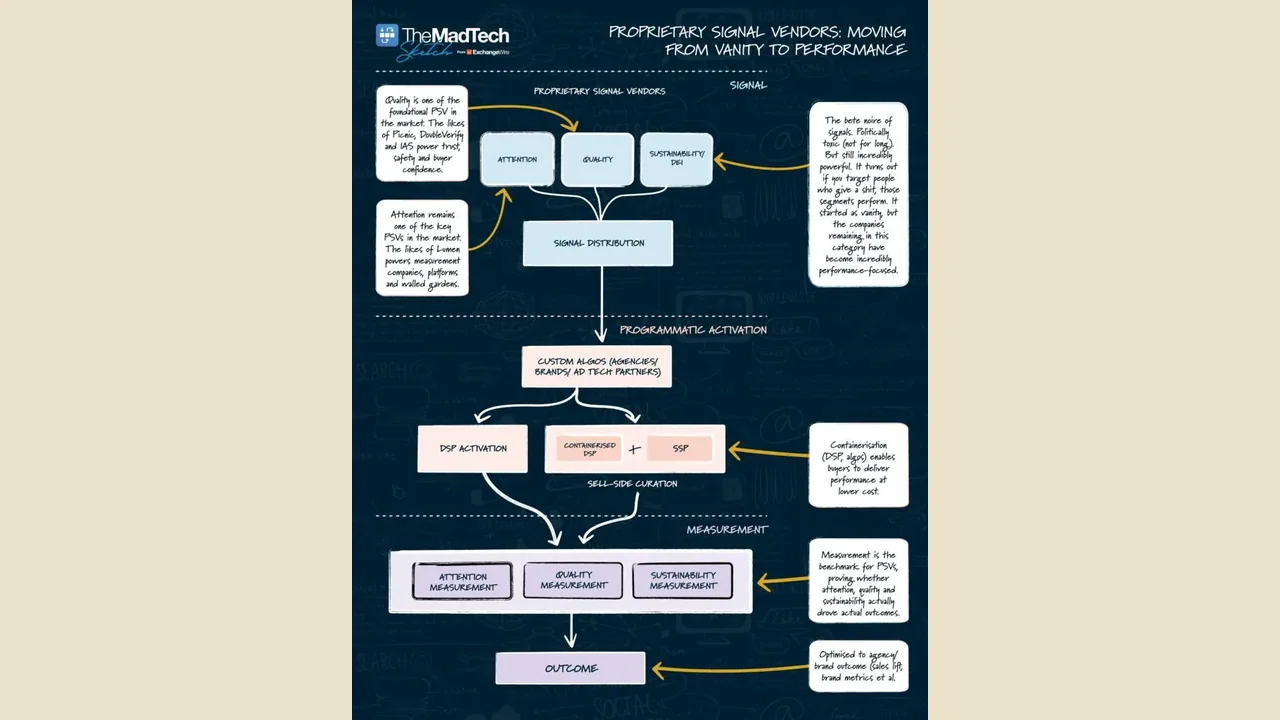
ExchangeWire's Ciaran O'Kane has coined a new adtech acronym, PSV, for Proprietary Signal Vendors. The term follows last year's SSA, or Super Signal Aggregator, a label ExchangeWire created for firms that combine brand safety, contextual and other signals with activation and measurement in one data stack. O'Kane argues these aggregators miss specific signals that buyers want, in areas such as attention, quality and sustainability, leaving room for specialist vendors to dominate each niche. Lumen, Picnic and The Goodnet will discuss the category on a panel at ATS London on September 15. The Goodnet has built an outcomes based business around sustainability signals, and O'Kane says PSVs have moved from vanity metrics toward performance focused signals that brands use to reach audiences who respond to them.

Adform Named Technology Platform Partner for ChatGPT Ads in Europe
Adform has been named a technology platform partner for the European rollout of ChatGPT Ads, giving European brands and agencies a route to activate on the format. ChatGPT Ads is already live in more than 40 markets, including the United States, the United Kingdom and Canada, and every week over one billion people use ChatGPT to research, compare and plan decisions. Volkswagen and Vodafone are testing the format through Adform, checking how it performs alongside their existing media activity. Running campaigns through Adform lets advertisers connect ChatGPT-driven results with their other activity in one integrated view, linking engagement in AI conversations to outcomes across the rest of the customer journey. Stefan Sommer, Adform's chief growth officer, called it "an important new advertising environment for brands and agencies."

Qortex: Nike ads perform 4x better against cooking content than NBA games
Media agency Coegi raised the video completion rate on a B2B YouTube campaign from 14% to 40% after using contextual video intelligence platform Qortex to shift ad placements from tech and business news toward educational videos about complex topics, said Hannah Schatz, Coegi's senior director of programmatic operations. Qortex, formerly known as CatapultX, analyzes video content to predict which categories will drive the strongest ad performance for a campaign, drawing on more than 5 billion consumer interactions the company has tracked. CEO Zack Rosenberg said Qortex's research found Nike ads perform four times better against cooking content than against NBA basketball content. Coegi's EVP of digital operations, Chris Kotyck, said the approach lets the agency prove unexpected content matches to clients "with no cost to you." Qortex now works almost exclusively with advertisers, betting that content-level signals predict purchase intent faster than traditional demographic data.

Yandex Direct publishes Real Time OTS methodology for DOOH ad pricing
Yandex Direct has published the methodology behind Real Time OTS (Opportunity to See), the metric it uses to price digital out-of-home advertising by the thousand potential contacts recorded at the moment an ad plays. A contact counts only when a person is located within the geometric visibility zone calculated individually for each screen. In pedestrian zones the system excludes people moving faster than 15 km/h, such as those on scooters, bikes or in vehicles, since they have no physical opportunity to see the message. Rooftop taxi displays apply a similar cutoff at 30 km/h. The model runs on aggregated, anonymized traffic data from Yandex services, calibrated against mobile operator datasets and checked against physical on-site measurements. Yandex reports that unexpected snow in Moscow in late April cut reach by 20% to 29% as pedestrian traffic dropped, and an ad that runs during a storm can cost a brand ten times less than the same spot in good weather.

Mile Marker, Go Fish, Crispin add AI clauses to contracts via addendums
Agencies including Mile Marker, Go Fish and Crispin are adding AI-specific clauses and addendums to their Master Service Agreements, Digiday reports. Reed Smith advertising group partner Keri Bruce said clients want disclosure of which AI tools touch their accounts. Mile Marker CEO Scott Shamberg said his agency builds AI terms directly into existing MSAs to cover metadata management, IP ownership and tool transparency, since AI rules vary by client. Go Fish has added brand safety and data protection clauses over the past six months, and Crispin uses addendums when a project needs one. VML global chief innovation officer Brian Yamada said agencies need flexibility in contracts because AI cost structures remain unsettled. Go Fish president David Dweck said his agency still bills clients hourly: 'We'd rather stay with what's familiar and how advertisers are paying agencies for a century versus trying to change the game up by trying to be a SaaS company.'

AdExchanger op-ed: Magnite, Raptive build owned AI layers as ad tech eyes build-vs-buy
Magnite is rebuilding its SpringServe platform to bring AI-driven demand routing, price setting and buyer-seller agent coordination in house, one of several moves cited in an AdExchanger op-ed arguing that ad tech companies are building or buying an AI operational layer for the business itself. Raptive has launched an intelligence division, appointed a chief AI officer and acquired an AI company to do the same. The piece, written by a TeqBlaze executive, argues that tools sit next to the work while an operational AI system sits inside it, wired into a company's documentation, monetization stack, databases and CRM tools. TeqBlaze built its own internal system, TeqMate AI, before clients began asking what the company used internally, a shift the piece says is how TeqMate stopped being just an internal tool. The author frames the next few years as splitting ad tech between companies that own this infrastructure and those renting fragmented, per-seat tools.

IAB issues AI measurement guidelines, leaves attribution unresolved
The IAB has published new guidelines for measuring AI's influence on advertising, built around shared vocabulary and quality standards for vendors claiming to track "AI visibility," ExchangeWire's Shirley Marschall writes in a column published September 9th. The guidelines leave attribution itself for a promised future framework. The push comes as AI chats increasingly shape purchase decisions inside conversations that may never produce a click: a shopper can spend twenty minutes comparing brands with ChatGPT, close the tab, and later type a brand name directly into Google, with the AI exposure going unrecorded in any dashboard. ChatGPT has reportedly reached a $1bn annualised advertising revenue run rate after just six months of running ads in chats. A CIMM report cited in the piece finds marketing mix models are increasingly wired directly into automated bidding systems, where their output now executes budget decisions on its own.

11 retail media networks pitch measurement and reach to advertisers in New York
Fifteen retail and commerce media businesses pitched their advertising platforms to agencies and brand marketers at an event in New York City last week, organized by Ascendant Network for commerce media networks. Presenters included The Home Depot's Orange Apron Media, Albertsons, PayPal Ads, DoorDash, Chase Media Solutions, Macy's Media Network, Dick's Sporting Goods and Instacart. Home Depot's Kailey Emery cited a 30% jump in brand trust and a 40% boost in purchase intent for brands placed alongside its content. Chase's Lauren Griewski pointed to more than $1.9 trillion in debit and credit sales data from 2025. Albertsons said ad placements next to its Rico's Tacos video series beat benchmarks by 200%. Executives across the group pointed to incrementality measurement, cross-channel data and upper-funnel video as the areas where their networks compete for ad budgets.

Adweek and Code and Theory to teach AI dashboard building at Brandweek Sept. 18
Code and Theory will run a masterclass on building AI-powered dashboards at Adweek's Brandweek conference on Wednesday, September 18, from 1 to 1:45 p.m. at the Spotlight Stage North. Karen Piper, the agency's head of strategy, and Pete Steiner, head of Creative Labs, will teach attendees how to select datasets, shape the data and automate a dashboard that updates continuously. Piper builds a fresh dashboard for every client pitch, pulling data and case studies from different teams and formats into one place. Steiner's dashboard tracks every project his Creative Labs team runs, including its status, who is assigned to it and what resources are attached, at a time when his team members are each juggling three or four projects at different stages. The session also covers scoping a dashboard before building it, treating the plan like a product requirement document. Space at the session is limited and entry is first-come.

Sanofi tests AI lab-in-a-loop to speed drug discovery, AdExchanger op-ed says
Sanofi is developing a lab-in-a-loop that uses AI agents to potentially compress elements of drug discovery from years to weeks, according to an AdExchanger op-ed by Ian Colley. The pharma industry currently spends $2.6 billion and 12 to 15 years to bring a new treatment to market, with a 10% success rate. Over the past decade, the share of FDA drug approvals addressing rare conditions has risen from below 30% to above 50%, the piece notes, as AI opens more research toward smaller patient populations. That progress creates a marketing problem: reaching a few thousand patients and their doctors costs more per person than reaching a mass audience. Ultragenyx launched Crysvita in 2013, the first treatment for X-linked hypophosphatemia, and it initially struggled until the company shifted to disease education and free gene testing. Early tests of agentic AI tools have cut marketing planning and execution cycles for new treatments by as much as 10x, per the op-ed.