

Digest of the day
August 18, 2026
9 stories
Truthset finds 40% of open US CTV programmatic spend, $7.4bn, is wasted on bad data, while WPP and TikTok's study of 1,200 campaigns shows creator ads lift brand recall 23% over standard formats. Demandbase reports ChatGPT referrals to B2B sites jumped 303% to 2.6m monthly visits, and Meta began charging advertisers location fees up to 5% in Turkiye, Austria and other markets.

Open-source marketing mix modeling tools gain traction as AI agents lower entry barriers
Julian Runge, an assistant professor of marketing at Northwestern University, told AdExchanger that open-source marketing mix modeling (OS-MMM) packages including Google's Meridian, Meta's Robyn and PyMC-Marketing are gaining adoption as privacy rules like GDPR, COPPA and Apple's IDFA deprecation erode traditional attribution. Runge, co-author of the first academic paper on open-source measurement, said agentic AI tools such as Claude, ChatGPT and Gemini can now pull these packages, load campaign data and estimate a model from natural-language prompts, opening the process to people with no data science background. He cautioned that human oversight remains necessary to vet results and avoid decisions based on flawed AI-generated analysis. Runge expects marketing mix modeling, controlled experiments and attribution, what Meta calls the 'suite of truth,' to remain the standard measurement stack for the foreseeable future, with multi-touch attribution outputs still needing cross-checks against experiments.
Truthset report: 40% of US open CTV ad spend, $7.4bn, lost to bad data
Truthset's 2026 State of Data Accuracy report finds that roughly 40% of every dollar spent on the open US CTV programmatic market, an estimated $7.4bn, is wasted because of inaccurate data. Nano Interactive's Kelly Jahrnes points to broken content-object fields in the bidstream: content ID, title, episode and genre data are often optional, inconsistent or labeled differently across publishers, so a Peacock episode ID for The Office won't match Hulu's ID for the same episode. Brand safety flags for violence, abuse or suicide are frequently missing too. Buyers fall back on proxies such as app lists, Deal IDs and completion rates, which can mask real problems: an ad completed in a screensaver environment counts the same as one completed during a live sports stream. Repeated ads in the same break, a symptom of this identity gap, have been linked to a 16% decline in purchase intent.

Eric Picard: agentic ad platforms need deterministic guardrails around real budget spend
Eric Picard, writing in AdExchanger's Data-Driven Thinking column, argues the ad industry needs firm rules for where large language models can operate inside agentic advertising systems. He points out that an LLM can answer the same prompt five different ways even with identical context, useful for drafting and reasoning, risky for any step that touches live budget. Picard says buyers running high-volume automated campaigns cannot review every change by hand, and automation cannot make decisions nobody approved either. His proposed fix: define upfront what actions are allowed, what needs human sign-off and what runs automatically, then let a deterministic system execute inside those limits. He places the LLM at the interface, translating a buyer's intent into instructions, while execution stays on deterministic, rule-governed infrastructure built on years of real ad spend.
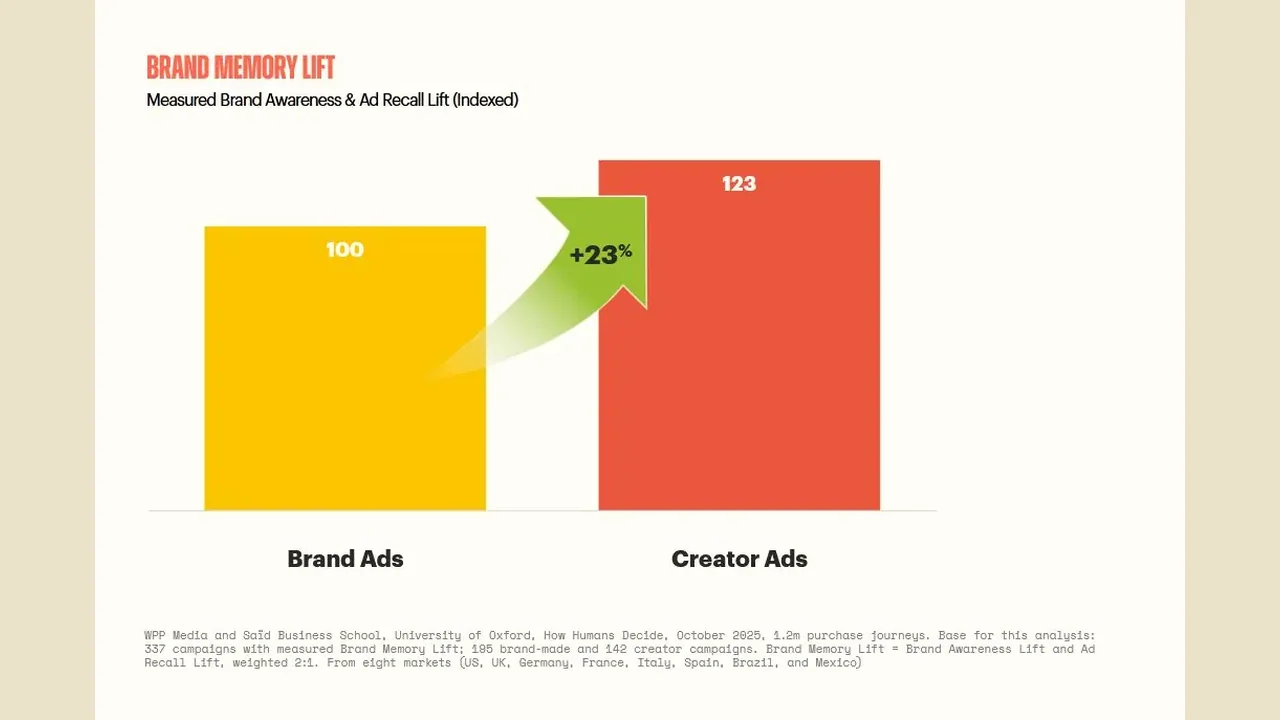
WPP Study: TikTok Creator Ads Lift Brand Recall 23% Over Standard Ads
WPP, System1 and TikTok analyzed 1,200 paid TikTok ad campaigns, together spanning 23.6 billion impressions, and tested reactions among 182,500 users across eight markets: the US, UK, Germany, France, Italy, Spain, Brazil and Mexico. Of the ads studied, 620 featured content creators. Standard brand ads matched or beat creator ads in most individual cases tested, yet creator ads produced a 23% higher average brand recall lift than standard short-video ads. Three factors drove the result: creative quality, creator fame and the fit between creator and brand. When all three aligned, recall lift reached nearly four times the level of weak combinations. Creator-brand fit carried about twice the weight of fame in driving recall. Only 61% of creator ads placed a recognizable brand element within the first two seconds.
VK Video cuts monetization threshold fivefold to 1,000 subscribers from Sept. 1
VK Video will lower its monetization threshold from 5,000 subscribers to 1,000 starting September 1, 2026. Creators must also publish original content and log at least 500 hours of total watch time over the trailing 90 days, with a three-month adaptation period for those who fall short. VK says the change is meant to widen access for emerging creators while keeping the program's focus on channels that post original content regularly and grow their audience. Mediascope puts VK Video's average daily active audience at roughly 4 million people in the first half of 2026, excluding views through embedded players on third-party sites. VK has separately reported the platform's total audience reached 42.2 million users in January 2026, up from 41.1 million in December 2025.
ChatGPT referrals to B2B sites jump 303% to 2.6m a month, Demandbase reports
Monthly ChatGPT referral visits to business-to-business websites reached 2.6 million in June 2026, up from about 645,000 a year earlier, according to Labs by Demandbase, released August 12, 2026. The increase, 303% year over year, was uneven: growth accelerated sharply in May 2026, when referral traffic more than doubled against prior months, a jump Demandbase does not attribute to any specific product or measurement change. Perplexity referrals declined over the same period while Gemini and Claude held flat, leaving ChatGPT as the dominant source of AI-referred traffic in the dataset, which covers more than 11 billion visits across 1,584 platform tenants. Demandbase CMO Rachel Truair said much of B2B buyer research with AI assistants happens before a visit to a brand's site, urging marketers to reinforce presence across advertising, content and sales channels since AI referral volume remains a small share of total measured traffic.
Russia plans to ban Telegram advertising from 2027, ad volume up 50%
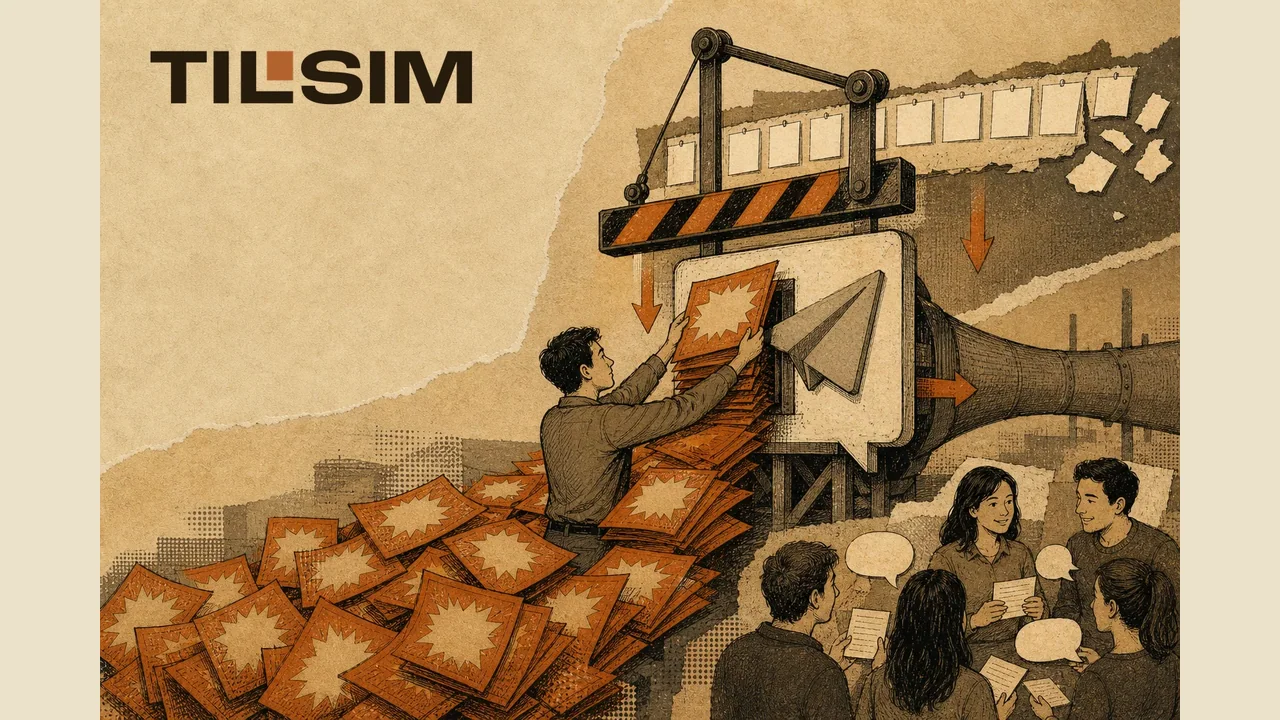
Russia's competition regulator, FAS, has said penalties for Telegram advertising will not apply until the end of 2026, but a full ban on paid promotion is expected from January 1, 2027, according to ppc.world. More than 75% of companies used Telegram for marketing in 2025, and ad publications on the platform rose 50% in March 2026 compared with March 2025 as brands rushed to capture reach before the deadline. Roskomnadzor has already begun throttling Telegram access. Once the ban takes effect, brands will lose the ability to advertise product advantages directly or run price-driven calls to action. Expert posts, customer chat, price listings without purchase prompts, and brand mentions seeded through influencers are expected to remain allowed, pushing marketers toward native content formats built on insight, commentary, and organic brand mentions.

Meta rolls out location fees up to 5% to offset digital ad taxes in Turkiye, EU, UK
From 1 July 2026, Meta began charging advertisers location fees to offset digital services taxes and other local regulatory costs: 5 percent in Turkiye and Austria, 3 percent in France, Italy and Spain, and 2 percent in the United Kingdom. The move follows a spread of digital ad taxation across the South Caucasus and Central Asia, where governments are moving to tax revenue earned by platforms based outside their borders. Kazakhstan's State Revenue Committee reported 146.5 billion tenge in VAT collected from foreign digital companies since its mechanism began, including 57.6 billion tenge in 2025 alone, with 123 foreign taxpayers registered, among them Meta, Google, Apple, Microsoft, TikTok and OpenAI. Azerbaijan will require non-resident digital service providers with over $10,000 in annual B2C turnover to register for e-VAT from 1 September 2026. WARC forecasts Alphabet, Amazon and Meta will hold 58 percent of ad spending outside China in 2026, up from 56.1 percent in 2025.
DirecTV launches Curated Multiviews to bundle live sports games in one screen
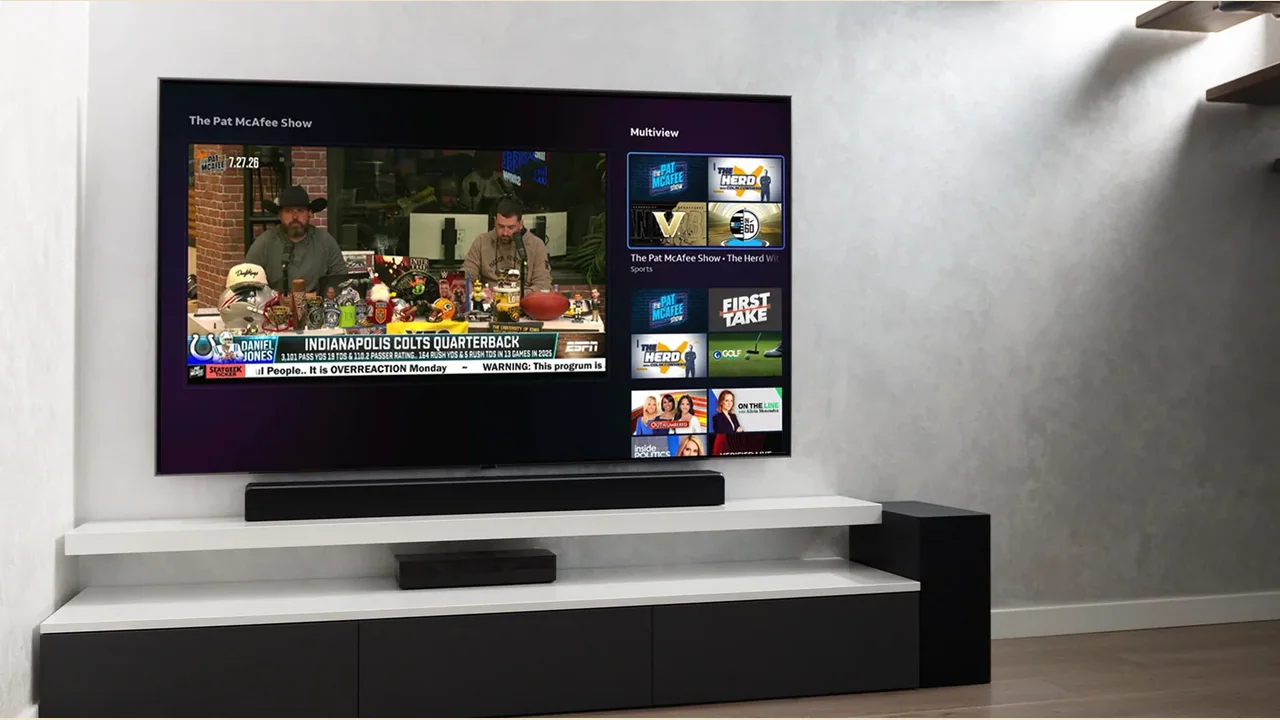
DirecTV will roll out Curated Multiviews to eligible customers by August 27, a new feature that groups live sports games into a single screen based on the day's schedule. The company's sports team builds each Multiview around marquee matchups or themed slates, such as an SEC Saturday lineup or a Sunday collection of NFL games on CBS and FOX. A Multiview button appears in the video player when one is available for the game a viewer is watching, and Multiviews only include networks already in that customer's package and games available in their area. DirecTV said the feature sits alongside its existing Mix Channels, which keep a fixed lineup of live networks such as sports, news and weather on screen at all times. Multiviews will surface in the Sports Central carousels as the rollout continues.